Tag: appreciative design

  • Appreciative Design & Soft Systems

    Appreciative Design & Soft Systems

    Appreciating The Context of Organizational Activity

    Human-centered design requires that we understand – or rather, appreciate – the need for changes to a “real-world” situation that is viewed as a governed by business logic and goals – rather than the engineering logic employed for IT system requirements. The intention is to improve how we understand the need for change – and the systemic impacts of making changes – through an iterative learning process based on Vickers’ concept of Appreciative Systems (Vickers, 1968; Checkland, 2000b).

    Geoffrey Vickers observed the diversity of norms, relationships, and experiential perspectives among those involved in, or affected by, a system of human-activity such as that found in business work-organizations. He argued that organizational change analysts needed methods for analysis that explored how to reconcile these perspectives, developing the concept of an “appreciative system,” the set of iterative interactions by which members of an organization explore, interpret, and make collective sense of their shared organizational reality (Vickers, 1968).

    The Concept of an Appreciative System
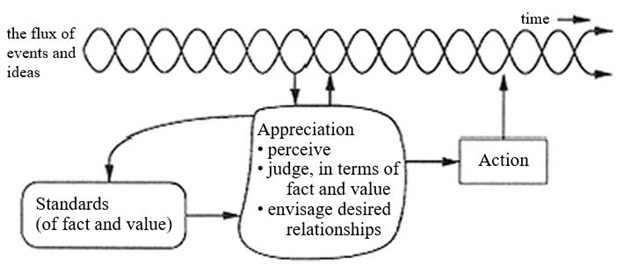
    The Concept of an Appreciative System Source: Checkland and Casar (1986), via Checkland (2000b)

    Vickers conceptualized organizational work as a stream, or flux, or events and ideas that were interpreted by participants in the organization by means of local “standards,” reflecting shared interpretation schema and sociocultural values (Checkland and Casar, 1986). Interpretations of new events and ideas are subject to the experiential learning that resulted from prior encounters with similar phenomena; these will vary across stakeholders, depending on how they interpret the purpose of the system of work-activity. To achieve substantive change, we need to understand and reconcile these multiple purposes, integrating requirements for change across the multiple system perspectives espoused by various stakeholders. These are separated out into distinct perspectives, which model subsets of activity that are related to a specific purpose or group of participants in the problem situation (Checkland, 1979, 2000b).

    Diagram showing investigation of a complex, real-world situation vs constructing models that represent the real world
    Real-World Analysis Vs. Systems Thinking About the Real World

    While both real-world analysis and systems thinking about the real world aim to produce representations of complex situations, the key difference lies in their focus: real-world analysis primarily examines data from actual scenarios to identify patterns of human-activity, relationships between actors, and issues that affect performance, whereas systems thinking takes a broader view by considering the interconnectedness of elements within a system, analyzing how they interact and influence each other to understand the big picture – and to engage in debate about how it may be improved.

    The concept of appreciative design underpins Soft Systems Methodology (SSM), an approach devised by Dr. Peter Checkland of Lancaster University in the UK, to capture and make sense of complex change requirements across multiple goals for change and the multiple rationales that underpin any organizational system of work-activity. SSM is now a highly-regarded approach to managing complex change, especially suited to the untangling of “wicked problems” (Rittel, 1972). Its contribution is to separate the analysis of “soft systems” of human-activity – what people do in their work and the logic that makes sense of that activity – from the “hard system” of IT and engineering logic that usually underpins system requirements.

    Soft Systems Methodology (SSM)

    The development of integrative system thinking methods and analysis techniques to solve ill-structured, “soft” problems is Checkland’s (1979) contribution to the fields of change management and systems analysis. Soft Systems Methodology (SSM) provides a method for participatory design centered on human-centered information systems. The analysis tools suggested by the method — which is really a family of methods, rather than a single method in the sense of modeling techniques — permit change-analysts, consultants and researchers to surface and negotiate feasible aspects of change, to explore and reconcile alternative viewpoints, and to anticipate (to some extent) the knock-on effects of changing one part of a complex system of work on other parts of this system.

    Problems are ultimately subjective: we select things to include and things to exclude from our problem analysis (the “system boundary”). But real-world problems are wicked problems, consisting of interrelated sub-problems that cannot be disentangled — and therefore cannot be defined objectively (Rittel, 1972). The best we can do is to define problems that are related to the various purposes that participants pursue, in performing their work. By solving one problem, we often make another problem worse, or complicate matters in some way. Systemic thinking attempts to understand the interrelatedness of problems and goals by separating them out.

    In understanding different sets of activities and the problems pertaining to those activities as conceptually-separated models, we understand also the complexity of the whole “system” of work and the interrelatedness of things – at least, to some extent. It is important to understand that, given the evolving nature of organizational work, a great deal of the value of this approach lies in the collective learning achieved by involving actors in the situation in analyzing changes, and that this approach in inquiry is, in principle, never ending. It is best conducted with and by problem-situation participants (Checkland, 2000b).

    Summary

    To summarize, appreciative design is an approach where emergent perspectives on what a “system” of work should achieve and how that work should be performed are modeled to produce actionable changes to the system that can be evaluated around agreed standards of performance and that preserve desired relationships between human actors and between elements of work-activity and their outcomes. This approach to modeling work-systems influenced the development of Soft Systems Methodology (Checkland, 2000b), a method to operationalize the representation and negotiation of systems of purposeful human-activity around which desirable and feasible changes can be identified and implemented.

    References

    Checkland, P. (1979)  Systems Thinking, Systems Practice. John Wiley and Sons Ltd. Chichester UK. Latest edition includes a 30-year retrospective. ISBN: 0-471-98606-2.

    Checkland P., Casar A. (1986) Vickers’ concept of an appreciative system: A systemic account. Journal of Applied Systems Analysis 13: 3-17

    Checkland, P. (2000a) New maps of knowledge. Some animadversions (friendly) on: science (reductionist), social science (hermeneutic), research (unmanageable) and universities (unmanaged). Systems Research and Behavioural Science, 17(S1), pages S59-S75. http://www3.interscience.wiley.com/journal/75502924/abstract

    Checkland, P. (2000b). Soft systems methodology: a thirty year retrospective. Systems Research and Behavioral Science, 17: S11-S58.

    Checkland, P., Poulter, J. (2006) Learning for Action: A Short Definitive Account of Soft Systems Methodology and its Use, for Practitioners, Teachers and Students. John Wiley and Sons Ltd. Chichester UK. ISBN: 0-470-02554-9.

    Rittel, H. W. J. (1972). Second Generation Design Methods. Design Methods Group 5th Anniversary Report: 5-10. DMG Occasional Paper 1. Reprinted in N. Cross (Ed.) 1984. Developments in Design Methodology, J. Wiley & Sons, Chichester: 317-327.: Reprinted in N. Cross (ed.), Developments in Design Methodology, J. Wiley & Sons, Chichester, 1984, pp. 317-327.

    Vickers G. (1968) Value Systems and Social Process. Tavistock, London UK.

  • Why The IKEA Font Matters

    Why The IKEA Font Matters

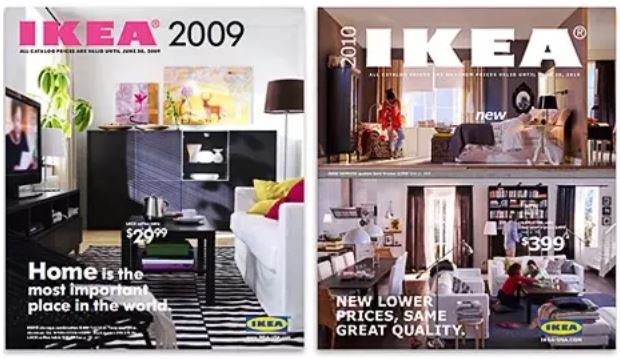
    People have been commenting on the change of font used by IKEA for their catalogs since August, when the new catalog came out. IKEA had used the Futura font for 50 years, but made the decision to adopt Microsoft’s Verdana font this year. Apparently, because it translates well to numerous languages.  Take a look at the two catalog examples in this picture.  Ignoring that the too-busy 2010 cover looks like they are trying to appeal to the attention-deficit generation,  the 2010 catalog could be anybody’s while the 2009 catalog is distinctively IKEA.  If you took the brand-name off the catalog, you’d know exactly whose it was.

    IKEA font

    This is important because design is about more than a satisficing appearance. We tend to mock style over substance, but style plays another role in design. It reinforces the emotional response to artifacts that we have and it provides us with clues (affordances) that tell us how to respond to those artifacts. There is an aesthetic to design that makes the difference between something that is a joy to use and something that just does the job. Sometimes that aesthetic is as simple as the tactile response to a Pilot G2 pen (one of the mundane artifacts that tends to rouse a lot of passion in its users). Sometimes it is the lack of cognitive effort in being able to distinguish the utility of one artifact over another because of its appearance. Sometimes, it is just the comfort of recognizing a familiar artifact, that one knows how to use.

    For all of these reasons, IKEA’s decision seems stupid. They had a brand recognition that people would die for, based on the use of the Futura font. Yes, this may be a sad thing to obsess over. But the familiarity and distinctiveness of the IKEA catalog is gone. And I, for one, mourn its passing.