Category: design

  • Design as Bricolage.

    Design as Bricolage.

    When attending a boundary-spanning design meeting the other day, I was reminded of how important pattern sensitization is to design. When we explore a new problem-situation, we structure it according to the patterns that we perceive in that situation. This is why experienced designers are so much better at design than novices. It is not that experienced professionals are sharper, or better at design — but just that they have a wider repertoire of patterns to call upon. As they recognize familiar elements of the situation, they fit partial solutions to those elements. Problem decomposition is not hierarchical, in the sense proposed by Alexander (1964), but convergent. The problem-space and the solution-space co-evolve, as designers explore these in tandem (Maher and Poon, 1996; Maher and Tang, 2003).

    Back to the meeting.
    A group of strategic managers (including the systems people and the business process change manager) were examining how to revise business process support for a routine workflow. The problem that they faced was that this had been adapted by several workgroups (whose representatives were present) over time. So each of these managers had a different perspective of the problem, depending on what each group was trying to achieve. The customer support group were frustrated that they could not access all of the customer information in the system, but had to call another group to obtain missing information. The order-processing group were frustrated that they could not track the progress of an order without having to run three separate IT applications. The sales and marketing group were incensed that not all of the latest products and services were publicized on the website. None of these people – including the IT group managers – could see that these were related problems. They spent hours debating the fields to be displayed on the screens and the detailed reports needed, without realizing that the workflows were related.

    The breakthrough came by accident, when the Process Improvement Manager was mapping the “requirements” on a whiteboard. He started to link two of the requirements, stood back and then said “So this step is also related to this one, isn’t it?” Then the Marketing Manager said “That comes just before the promotions stage.” As the Process Improvement Manager drew a process diagram, each individual kept adding in pieces of the puzzle, with how they were related.

    Design as bricolage.
    Bricolage involves repeated “trying out” and experimentation until a pattern is discerned that is useful. (The word derives from Bricoleur, a French term meaning “handy-man” or “jack- of-all-trades.”) Claudio Ciborra described bricolage as “the constant re-ordering of people and resources that is the true hallmark of organizational change.” But Bricolage is not random experimentation. It is based on leveraging the world “as defined by the situation” (Ciborra, 2002). Pattern sensitization adds another dimension to bricolage. It can now be seen as an ordering of situation elements until they make sense according to previously encountered patterns. So design is like a jigsaw. Each person carries around a partially-completed set of jigsaw pictures in their heads. The core problem of design is to use a problem-representation that can allow people to communicate the structures in their “mental jigsaw picture” to others.

    bricolage

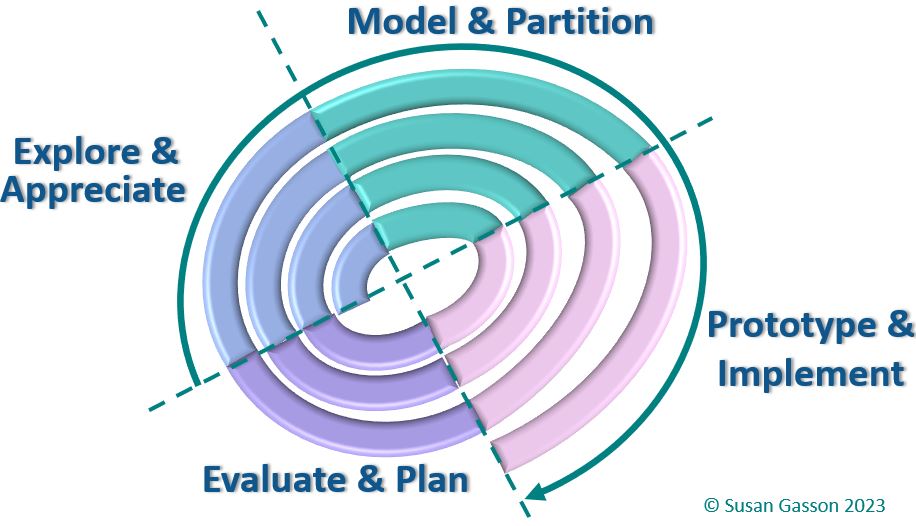
    The Process of Bricolage

    References
    Alexander, C. Notes On The Synthesis Of Form. McGraw Hill, New York NY, 1964.
    Ciborra, C.U. The Labyrinths of Information: Challenging the Wisdom of Systems Oxford University Press, Oxford UK, 2002
    Maher, M.L., and Poon, J. “Modelling design exploration as co-evolution,” Microcomputers in Civil Engineering (11:3) 1996, pp 195-210.
    Maher, M.L., and Tang, H.-H. “Co-evolution as a computational and cognitive model of design ” Research in Engineering Design (14:1) 2003, pp 47-64.

  • Design as the Serendipity of Location

    Design as the Serendipity of Location

    As I ruminate on design processes, I can’t help but reflect on the similarities between research methods, processes and outcomes, and design methods, processes and outcomes. I read an article which argued that there were two types of people: people with tidy offices and people with untidy offices1. Tidy-office people are organized and so can find anything they need. These are the people who work top-down, creating an outline then writing or designing according to that scheme. Untidy-office people are disorganized, spend a great deal of time searching for things, but also tend to be more creative because they are inspired by things which they bump into, while looking for other things. These people work bottom-up, assembling elements into a coherent whole. The article argued that there are cognitive rewards in both styles of working, that lead people to subconsciously adopt one or the other style consistently.

    I was reflecting on this as I try to make sense of the piles of material that I have assembled for the book. I am definitely an untidy-office type and I wonder if this has something to do with introvert/extrovert personalities? [My project management students and I just explored an online Myers-Briggs personality test; as expected, I was an INTP type.] Perhaps introverts just prefer a “life of the mind,” where we can construct inductive models of the real world?2.

    My semi-organized and shifting piles of research data, models and representations, interim findings, academic articles, and books provide a three-dimensional, systemic representation of design processes that can be reorganized as I comprehend different patterns. Of course, they are both preceded and supplemented by painstaking (and frequently revisited) processes of categorization, synthesis, and validation. But the kaleidoscope of patterns that they reflect is invaluable in suggesting different views of my findings. The same is true for design – we create the patterns that we perceive as relevant in the problem situation. As our perceptions shift, so do the design patterns that we follow.

    I would argue that innovative design is neither deductive or inductive, but consists of cycles of induction and deduction. It follows a hermeneutic circle of sensemaking, as designers attempt to work from problem to solution and to reconcile those fragments of a solution that they understand back to a meaningful problem definition. The combination of deductive and inductive thinking has been described as abductive reasoning, but reasoning about design is more disciplined and rigorous than most descriptions of abduction [a hunch] would indicate. I prefer Thagard and Shelley’s (1997) argument that hypotheses about reality are layered, incomplete, and too complex to be comprehended easily3. Often, the only way to comprehend complex, interrelated elements of behavior and context is to use a visual, systemic representation.

    As someone who has spent a good portion of their career as a systems designer, I have never considered design creative. Design is more about synthesizing from preconceived elements than creating from scratch4. But I wonder if – just as in research – the greatest inspiration in design derives from the serendipity of location?


    Footnotes (click onto return to post)
    1. If anyone knows the reference for this paper, please let me know. I saw an NYT article on the subject, but I can’t locate the academic paper again – which was published in an information science journal, if I recall correctly …
    2. There is a neat discussion of deductive vs. inductive reasoning over at the research methods knowledge base.
    3. Paul Thagard and Cameron Shelley (1997) “Abductive reasoning: Logic, visual thinking, and coherence.” Available at http://cogsci.uwaterloo.ca/Articles/Pages/%7FAbductive.html (last accessed 11/27/2009).
    4. Like sex, design seems to be 30% inspiration and 70% perspiration …
  • Human-Centered Design

    Human-Centered Design

    In the last few years, the terms human-centered and user-centered have become synonymous in HCI and IT design, with a focus on disciplines such as “user experience” and “interaction design.” Here I will argue that neither discipline really deals with the core issues of human-centered design.

    Human-centeredness in design involves designing technology artifacts, applications, and platforms that provide a “support system” to people performing specific work or play activities as individuals, or collaborating around a set of (more or less) well-defined aims – often messily and exploratively. Asking people to describe their requirements for technology to support them in their activity doesn’t work because no-body really stops top think about how they work, or what they do to achieve a goal. When they are forced to do so, they will describe how work should be done – the formal system of procedures and rules – rather than how it is done – the informal, socially-situated system that makes work activities fit with their environment and the objectives that people have.

    People are seldom alone in what they do, even when engaging in individual activity. They socialize with other people and exchange ideas, they seek advice on how to proceed, and they collaborate to achieve shared – or similar – goals. When confronted with a novel problem, most people turn to a “small world” network of trusted social contacts for input – people who share their values and perspectives – rather than conducting a wider search that includes subject experts and knowledge resources (Chatman, 1991). Even when working alone, we are never truly alone. We are thrown into a working environment that existed before we joined – a self-contained world of work and social activity that we can only understand through participation (Weick, 2004). Professionalism and practice in one organization are completely different to the practices and standards applied in another.

    When we try to understand the “user” of a software application or system, we often fail miserably because we only see the formal work activities that they perform. We miss the web of activities that their formal activity is a part of – the multiple other human-activity systems they interact with, to get things done.  User-experience design is reductionist in its focus on interaction design. It takes a human being, rich in purpose and understanding, and reduces them to the role of artifact user. Not only that, but by implication, the user of a pre-defined artifact, whose purpose is understood, but whose mechanisms of interaction remain to be fully defined. By focusing on conceptual models of use, user scripts, and activity/task frameworks for work-analysis e.g. Sharp, Preece, and Rogers (2019), it isolates the user from the social context of work, describing activities in terms of fixed procedures and embedding assumptions about how and why the artifact will be used. It loses the joyful multivocality of the human-centered approach to design. Instead of understanding that thrownness is a temporary state, where there is a choice between reaction or being proactive, user-centered design embeds reaction as a paradigm. It separates tasks from workflows, making each interaction an end in itself and enforcing the approach to design that led Lucy Suchman to write her famous treatise on situated design (Suchman, 1987, 2007). There is no linked flow of work processes, where the human being knows that (for example) they have already photocopied the report covers (onto special cardstock) and the early chapters, so now have only to copy later chapters. There is the dumb lack-of-saved-status machine, which jams halfway, then asks the user to reload the report pages in their original order, starting with the covers which need the user to load special cardstock into the paper feeder. Which they already did.

    We can support this world by understanding the various purposes of human activity and designing technology to assist in those purposes (Checkland and Winter, 2000). Human-centered design differs from user-centeredness by being systemic and multi-vocal: it is aware of the multiple networks of activity in which a human technology user engages, simultaneously. Unlike user-centered design, which focuses on a single, definable work-goal, human-centered design appreciates the multiple goals that people pursue simultaneously, for different purposes. Human-centered design appreciates the social and organizational context of work, employing analytical approaches and methods that explore the complexity of the activities that we do – and the social networks we inhabit to do them.

    Designing for humans rather than users is a choice:

    • Human-centered design explores the multiple, purposeful systems of human-activity that are required to achieve even simple work (or play) goals.
    • It treats the participants in a human activity system as autonomous individuals, not agents to be modeled, controlled, and curtailed. Human-centered design respects and supports the local knowledge required to act skillfully, using local knowledge and various forms of tacit or implicit knowledge to perform work that is often not recognized as knowledge work.
    • It recognizes that a social system of information exchange exists, of which the designed technology artifact or software is only a part, and that humans need to exercise a deliberative choice about what to record and why. Any computer-based system of data is part of a wider, human-network-based system of information.
    • Because it appreciates work as part of a wider social system,  human-centered design involves a conscious decision to support the informal communications and activities that keep the system of work connected and informed – for example, water-cooler conversations or phone calls. These informal channels produce more knowledgeable participants in the system of work, rather than resulting in recorded data records or written resources. They are often omitted from – or worse, designed out of – the formal system of “user experience design.”
    • Above all, it acknowledges that knowledge, understanding, and the meanings that we ascribe to work are emergent. We understand how to do things by doing them, then reflecting on what we did and how – after which we have a better understanding of how to do them next time. Designing any particular set of procedures into a computer-based system is not only a waste of time, but may be counterproductive, as we constantly improvise and improve on how we did things previously (learning-by-doing). Human-centered systems design allows the human to be in control of their work, rather than the IT system.

    So no – “user experience design” and “interaction design” do not support human-centeredness in work (or play). They seek to humanize the artificial processes imposed by transaction-based systems by associating these with perspectives that acknowledge the psychology of human activity, learning, and interactions with technology. But they don’t even scratch the surface of understanding situated, systemic activity. For that, you need to employ methods that complicate your perspective, such as Soft Systems Analysis (Checkland, 2000; Checkland and Poulter, 2006) – and to take human-centeredness seriously.

    To conclude, user-centered design – as the term is employed in HCI and UX – is not the same as human-centered design. User-centered design is aimed at mitigating and improving the experience of using a system of technology that was designed for another purpose than those the user prioritizes – to make money, to “engage” users on the website so they return (and spend more money), and to publicize the firm’s products and services. In contrast, human-centered design is an approach that starts with user values, priorities, and purposes. It seeks to afford uses of the system that fulfill how the user would like to access the features that they value and expect. It designs the flow of use-interactions around the expected user flow of work (or play), allowing the user to configure this flow how they want. It does not make you do illogical or stupid things, like reloading all the sheets in a photocopier feed in their original order, even when the copy failed on the last-page-but one. It does not make you enter the same information repeatedly, because the designer was too unimaginative to anticipate that a user might want to change some of the options they had selected earlier (e.g. when booking an airline ticket). And it doesn’t make you go through seven layers of a menu to reach the one page you need.

    Human-centered design is performed by people who talk to users, learn to think like users, and walk alongside them in their work. These designers not only prototype and evaluate their designs, but also listen to the feedback they are given. They value user input and see it an critical to their portfolio of design experience. In the design literature of the 1980s there was a lot of discussion of how user representatives would “go native,” when participating in design projects, learning to think like designers and subsuming the interests of their fellow users in the process. In the 2020s, we need to see more IT designers going native, learning to think like users, reworking IT system designs to support how users work, and valuing the aspects of system design that users value. That is human-centered design.

    References

    Chatman, E.A. 1991 “Life in a Small World: Applicability of Gratification Theory to Information-Seeking Behavior,” Journal of the American Society for Information Science (42:6), pp. 438–449.

    Checkland, P. 2000 “Soft systems methodology: a thirty year retrospective,” Systems Research and Behavioral Science (17), pp. S11-S58.

    Checkland, P., and Poulter, J. 2006. Learning For Action: A Short Definitive Account of Soft Systems Methodology, and its use Practitioners, Teachers and Students Chichester: John Wiley and Sons Ltd, 2006.

    Checkland, P., and Winter, M.C. 2000 “The relevance of soft systems thinking,” Human Resource Development International (3:3), pp. 411-417.

    Sharp, H., Preece, J., and Rogers, Y. 2019. Interaction Design: Beyond Human-Computer Interaction, 5th EditionWiley, UK, 2019.

    Suchman, L. 1987. Plans And Situated Action Cambridge MA: Cambridge University Press, 1987.

    Suchman, L. 2007. Human–machine reconfigurations: Plans and situated actions Cambridge, UK: Cambridge University Press, 2007.

    Weick, K.E. 2004. “Designing For Throwness,” in: Managing as Designing, R. Boland, J and F. Collopy (eds.), Stanford CA: Stanford Uniersity Press, pp. 74-78.

    Selected Papers:

    Gasson, S. (2008) ‘A Framework For The Co-Design of Business and IT Systems,’ Proceedings of Hawaii Intl. Conference on System Sciences (HICSS-41), 7-10 Jan. 2008. Knowledge Management for Creativity and Innovation minitrack, p348.  http://doi.ieeecomputersociety.org/10.1109/HICSS.2008.20.

    Gasson, S. (2005) ‘Boundary-Spanning Knowledge-Sharing In E-Collaboration’ in Proceedings of Hawaii Intl. Conf. on System Sciences (HICSS-38), Jan. 2005. http://doi.ieeecomputersociety.org/10.1109/HICSS.2005.123

    Gasson, S. (2003) Human-Centered vs. User-Centered Approaches To Information System Design, Journal of Information Technology Theory and Application (JITTA), 5 (2), pp. 29-46.

    Gasson, S. (1999) ‘A Social Action Model of Information Systems Design’, The Data Base For Advances In Information Systems, 30 (2), pp. 82-97.

    Gasson, S. (1999) ‘The Reality of User-Centered Design‘, Journal of End User Computing, 11 (4), pp. 3-13.

  • The Co-Design of Business & IT Systems

    Multiple Perspectives of “The Problem”

    Modern organizations are complex, and the sorts of problems that remain to be resolved using process redesign, IT systems design, or the combination of both that we call the co-design of business & IT systems can’t be defined around a simple set of issues. There are multiple managers and groups of stakeholders, with competing goals for change. Some of these overlap, some complement each other, and some are in conflict with those of other stakeholders. Even a group of people who work together will have differing requirements and goals, depending on their experience, their professional background, and their position in the organization. People understand the parts of the organization they have experience of. Those who have worked in multiple groups will have a much wider – and more complex – view of what needs to change than those who have worked in the same role for years.

    There’s a management consultancy joke that says if you get five stakeholders around a table, you’ll have at least fifteen different goals.

    The co-design of business & IT systems is like piecing together a jigsaw puzzle without the picture. You get an edge here and there, part of a building outline, or a connecting feature, but mainly you are assembling bits and pieces that are tacked together in whatever way makes sense at the time. Most IT analysts fudge this by merging stakeholder requirements for change under a single, vague business goal. But this doesn’t prevent the shift in focus between multiple objectives that stakeholders prioritize, as these become salient to the current area of design. Change analysts have to understand multiple business domains, as stakeholders’ requirements indicate different types of solution and the analyst attempts to integrate these around a coherent business vision.  Even business managers don’t really understand their processes – and know very little of the processes with which their area of responsibility interfaces. Conflicts, priorities, and omissions in change objectives are seldom realized as the logical analysis methods used for IT requirements don’t provide ways to map out the full scope of change – the big picture.

    We lack ways to represent the big picture of how the organization “works” in ways that would allow business managers to understand the implications of changing things. Business analysts, change managers, and IT systems analysts are in a no-win situation. They are expected to understand myriad interpretations of the business strategy, reconcile conflicting viewpoints on how business processes work, and somehow define a coherent set of change objectives that pleases everyone. All while business managers and stakeholders each understand only a fraction of what the business does.

    Goal-based design is a myth

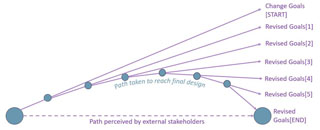
    In today’s complex organizations, very few design goals are understood to the point that they can just be stated and agreed across stakeholders. Design-goals are constantly changing between iterations, as shown in Figure 1. The designer starts by designing for the subset of goals they understand. As they explore and test the design with users, they become aware of new requirements and so modify the subset of goals they are designing for. As part of this process, they also discard any requirements that are no longer associated with perceived user needs.

    A trajectory of design showing a parabolic path between start and finish of project, governed by change-points where goals emerge and in turn modify the path of design

    Figure 1. Goal-emergence in design

    Organizational change requires repeated cycles of appreciation, enculturation, inquiry, learning, change, and evaluation – until the design is good enough. Not perfect – and certainly not optimal – good enough is good enough [2]. We talk about design as if it were fixed: as if there were one best way to design everything. We celebrate designers who produce especially elegant or usable artifacts as if they were possessed of supernatural powers. Yet design should be easy. It is the application of “best practice” principles to a specific situation. We can observe how the users of a designed artifact or system work, then design the artifact or system accordingly.

    Why does that approach fail so often? Because designers fail to design for changes to business processes.

    The co-design of complex organizational processes & IT systems

    We cannot implement changes to IT systems without changing the way in which people work, how work is organized, and what it achieves. Most often, achieving improved business goals is the whole reason for IT change, as business environments and competitors change – and our business strategy needs to change to match this (or anticipate it).
    The drivers of change are shown in Figure 2.

    Changes in business drivers lead to inadequate IT application support. This gap drives strategic business planning, which drives changes to business processes, IT applications, info services, and IT infrastructure

    Figure 2. Drivers of IT Change

    Because IT change is always accompanied by changes to how people work, we need to design IT systems to support the changes we want, rather than work against them. For example, if we want people to collaborate, designing a system that prevents people from sharing information is a non-starter. So we need analysis methods that models the various systems of work-activity, understands the complex purposes of these systems, and defines requirements for the IT system to achieve these purposes. As shown in Figure 2, IS applications support business processes – they do not define them. Too often, IT design is performed in isolation, by technical developers who do not understand how the business works.

    Figure 3 presents a revision of Leavitt’s diamond model (Leavitt, 1960), updated for the 2020s. The original model related four aspects of the organization – structure, technology, task, and people – in a diamond model that communicated how changing any of these factors impacted the others. In 1991, Michael Scott Morton updated the model, to place managerial processes at the center, redefining the four “diamond model” factors as structure, strategy, technology, and individuals & roles. Scott Morton also related the organization to the external technological and socioeconomic environment.

    Updated version of Leavitt's diamond, relating organizational structures & management, business strategy & intelligence, people, knowledge & work activities, and data analytics, information & technology, to purposeful business processes at the center

    Figure 3. Leavitt’s diamond model, Updated for the 2020s

    The updated model presented here is my version of this framework. It presents the organization as situated within its environments – business/competitive, global, socioeconomic, and technological – rather than separate from these. Organizations are much more complex than in the 1990s. They incorporate multiple structures and power-centers/roles (management), business strategy cannot be separated from business intelligence, IT is integrated with data management and analytics, and people are identified with the work-activities they perform and the knowledge that they bring to their work. These four aspects of business organization are organized around the flows of high-level business processes that are performed to achieved each of the multiple purposes that the business exists to achieve.

    References

    Leavitt, H. J. (1964). Managerial psychology: An introduction to individuals, pairs and groups in organizations. Chicago: University of Chicago Press.

    Scott Morton, M. (1991) The Corporation of the 1990s: Information Technology and Organizational Transformation, Oxford University Press.

  • The Potential of Interaction Design

    The Potential of Interaction Design

    While browsing and working on a recent paper, I mused on the missed opportunity of interaction design. Reading Terry Winograd’s (1997) From Computing Machinery to Interaction Design, I was stunned to see how visionary this was, in the context of contemporary HCI thinking which focused on interactions with computer screen interfaces (still, sadly, the main focus of much HCI work).  Winograd saw computing as a “social and commercial enterprise” and saw the role of interaction design as situating technology within social and commercial processes. This thinking is related to Suchman’s (1987) Plans and Situated Actions: The Problem of Human-machine Communication, which saw human-computer-interaction as part of a stream of activity, located in the rationale of a wider sequence of tasks. While HCI theorists were fixated on task-analysis and screen-interface design, Suchman argued that we should see tasks as related to what had gone before and what was to follow.  Winograd argued that we should design technical artifacts to be useful in the larger context of social networks and the complexities of interactive spaces.

    I was reminded of this when reading a discussion of Don Norman’s (2005) Human-Centered Design Considered Harmful. In this essay, Norman argues that HCI designers focus on “human-centered design,” which he relates to support for tasks and artifact-interactions, when they should focus on “activity-centered design,”  related to the larger context of what people do. While I agree wholeheartedly with the sentiment (and applaud the fact that the idea will at last get an audience if Don Norman has taken it up), the concept of activity-centered design still misses the point that we need to understand how actors perceive their stream-of-reality, situated within both a social and a cognitive-processual context, for interaction design to fulfill its potential.

    In my 2003 paper, Human-Centered vs. User-Centered Approaches To Information System Design, I argued that human-centered design is not the same as user-centered design. User-centered design sees the human-being as a consumer of technology, whose reality is – somehow, magically – represented by the set of functions accessed via the computer artifact. This tends to be the focus of “traditional” HCI research. Human-centered design, on the other hand, sees the human-being as an autonomous individual, who may want to perform tasks in a different way, or a different order, to other computer “users.” They see the logic of what they do – and therefore the manner of its execution – as part of a socially-situated stream of activity that is meaningful to their understanding of work-processes and not some engineer’s idea of “best practice.” This means that design methods need to deal explicitly with problem inquiry, rather than just focusing on problem closure.

    In a new paper (hopefully to be accepted soon!), I have argued that situated interaction-design needs an analysis of two dimensions of the work that people do:

    • the formal vs. informal translations that need to take place, to locate work practice in both the social (unstructured-interaction)  and organizational (structured-interaction) worlds, and
    • the global vs. local translations that need to take place to locate work practice in both the situated and generically subjective worlds.

    Most of our design methods focus only on one quartile of this reality: the formal, structured world of data-processing. To really support interaction design, both education and practice need to take on a much wider scope.

  • Framing Information Systems

    A Framework For Behavioral Studies of Social Cognition In Information Systems

    Susan Gasson
    Drexel University, USA

    Please cite this paper as:
    Gasson, S. (2004) ‘A Framework For Behavioral Studies of Social Cognition In Information Systems,’ Proceedings of ISOneWorld Conference, Las Vegas NV, 14-16 April 2004.  Available from https://www.improvisingdesign.com/soc-cog/

    Abstract

    This paper examines framing processes in organizational information system definition, acquisition and use. Three theoretical lenses of social cognition are required to understand how individuals and groups frame IS problems and solutions. These are: (i) socially-situated cognition, (ii) socially-shared cognition, and (iii) distributed cognition. These three perspectives are often conflated in studies of that study mental models or framing in an IS context. The separation of analytical “levels” reveals different interiors of the “black box” of organizational IS design and adaptation, which are not well understood. In particular, this methodological framework highlights different assumptions concerning whether mental models are static or dynamic, and whether cognition is a property of individuals, groups, or technological systems.

    Keywords: Social Cognition, Technological Frames, Mental Models, IS Design, Sensemaking, Improvisation

    Introduction

    The study of socially-situated cognition is becoming increasingly common in the information systems (IS) literature An interest in theoretical concepts such as organizational sensemaking (Weick, 2001), situated action (Lave and Wenger, 1991, Suchman, 1987, 1998), technological frames (Orlikowski and Gash, 1994), organizational improvisation (Orlikowski and Hofman, 1997, Weick, 1998), technology adaptation (Majchrzak et al., 2000, Orlikowski et al., 1995), emergent knowledge processes (Markus et al., 2002), and distributed cognition (Hutchins, 1991) reflect an attempt to understand the ways in which aspects of individual and group understanding inform the definition, design, acquisition, use and adaptation of technological systems that are situated within a specific social and organizational-work context. But much of this work is ad hoc and fragmented, with little understanding of the traditions that underlie these theoretical concepts and the relationship between them.

    This paper is structured as follows. Section 2 presents a structured discussion of different theoretical perspectives that are incorporated into situated (or contextual) analyses of social cognition. The situated perspective is privileged here because contextual studies of social cognition are emerging as an important development in the organizational and IS literatures (Orlikowski and Gash, 1994, Porac, 1996, Resnick, 1991, Winograd and Flores, 1986). In section 3, a methodological framework is suggested for studies of social cognition in IS, accompanied by a discussion of how these concepts may be operationalized. Finally, there is a discussion of how this framework may be applied in IS research studies.

    Theoretical Perspectives on Framing

    The study of the processes by which human beings individually and collectively interpret, bound and make sense of phenomena and social interactions in the external world originated in the fields of cognitive and social psychology. Human beings are thought to act according to internal, cognitive structures that represent or symbolize external reality, constituting a language of thought (Fodor, 1975). These structures are variously referred to as schemas (Bartlett, 1932, Neisser, 1976), personal constructs (Kelly, 1955), scripts (Schank and Abelson, 1977) or mental models (Gentner and Stevens, 1983, Johnson-Laird, 1983). Earlier notions of cognitive processing emphasized information processing over the construction of meaning; the importance of both context and meaning became de-emphasized as a result (Bruner, 1990). More recently, human cognition has been viewed as a process that is situated within a socio-cultural context (Porac, 1996, Suchman, 1987, 1993). Thus, meaning “derives from an interpretation that is rooted in a situation” (Winograd and Flores, 1986, page 111). Mental models become more complex, abstract and organized with experience: this is pertinent in the IS profession, where experiential knowledge is valued because it brings an increased capacity for abstraction (Vitalari and Dickson, 1983).

    These cognitive structure concepts from the psychology literature converge, and are extended to organizational research, in the notion of a “frame” (Goffman, 1974, Tannen, 1993). Framing operates at the intersection of a psychological-cognitive and a social-behavioral approach to human interaction (Ensink and Sauer, 2003). In framing a problem-situation, an individual both structures and bounds those elements of the situation that they consider relevant, just as a film-director frames a scene.

    Framing As Socially-Situated Cognition

    Underlying any study of social interaction is the understanding that individuals inhabit a socially constructed world and through their actions, reproduce and give meaning to that world (Berger and Luckman, 1966, Kelly, 1955). Individuals operate within distinct “social worlds” (Strauss, 1978, 1983) or “communities of practice” (Brown and Duguid, 1991, Lave and Wenger, 1991): local workgroups possessing their own social norms, social expectations and specific genres of communication. But people are also members of multiple social worlds, as their work and personal experience intersects with the knowledge and interests of different groups (Strauss, 1983, Vickers, 1974). Thus, organizational problems and meanings are not consensual but emerge through interactions between the various social worlds to which decision-makers belong. People behave according to “structures of expectation” (Tannen, 1993) that guide how they predict and interpret the behavior of others. Such structures are partly culturally-predetermined and partly based on prior experience of similar situations (Boland and Tenkasi, 1995, Minsky, 1975, Schank and Abelson, 1977, Tannen, 1993).

    Communications are framed both within a specific, situational context and from an individual perspective (Ensink and Sauer, 2003, Tannen, 1993). Individuals provide conversational cues, on the basis of which hearers are able to place the communication within a specific context. But an individual cannot contribute to a discourse without displaying their view on the subject matter. Thus, individual frames are not static, but subjected to change during communicative and social interaction (Boland and Tenkasi, 1995, Ensink and Sauer, 2003, Eysenck and Keane, 1990). Suchman (1987, 1998) demonstrates how shared definitions of technology and work spaces are produced and reproduced through interactions between technology, people and potential work-spaces. Managers and workers make sense of their organizational environment and innovate through improvisation, to determine what works in practice and how it may be changed (Middleton, 1998, Orlikowski and Hofman, 1997, Weick, 1998, Zack, 2000). Organizational processes may no longer be viewed as static, but as “emergent knowledge processes” (Markus et al., 2002). Knowledge and meaning therefore derive from situated, shared experience, interpreted through continual adaptation and improvisation (Markus et al., 2002, Middleton, 1998, Weick, 1998, Zack, 2000).

    The core problem, in determining how people frame a specific situation, is that of making evidence of internal, cognitive framing structures visible, for analysis. Bruner (1990) use of storytelling as a way to elicit implicit perspectives is well-established (Boje, 1991, Gershon and Page, 2001, Mitroff and Kilmann, 1975). However, it must also be recognized that people invent or post-rationalize narratives, as a way of making sense of uncomfortable or inappropriate behavior and situations (Angus, 2001). Boland and Tenkasi (1995) suggest that narrative be combined with techniques to stimulate reflexivity (Schutz, 1967) and also suggest the use of cognitive maps (Axelrod, 1976, Eden et al., 1983) to elicit implicit reasoning. Most studies of situated framing employ a discourse analysis of interview data, observation, or technology interactions. Rommes (2002), in a “thinking aloud” study of Internet interactions, found that the way in which first-time users interpreted the city metaphor in their use of a digital city internet resource was very different to the way in which technical designers framed the ‘city’ metaphor. Jacobs (2001, 2002) employed discourse analysis and a co-term analysis of survey data, to compare framing constructs held by members of different professional groups. He concluded that the similar life-experience of members of specific groups led them to frame the role of information technology in similar ways. Prasad (1993) interviewed and observed members of diverse occupations, in a computerization project at a large health-services organization. He concluded that the way in which technology was interpreted resulted from sociocultural influences, such as membership of a specific professional group, combined with the ways in which their local managers and opinion-makers ascribed meaning to the technology. For example, managers who advocated use of the new information system by ascribing human qualities to it, such as smartness or knowledgeability, raised expectations of how the technology would behave that were widely adopted by those who worked for them and which were often at odds with their experience. From these studies, it can be seen that meaning and expectations are affected both by life-experience (derived through membership of a specific social or work-group) and also by interactions with other individuals who work in the same context.

    Socially-Shared Cognition

    Groups of people who regularly work together on shared tasks have been observed to develop a repertoire of shared frames. Shared frames provide cognitive “shortcuts” that permit a group to share common interpretations of the organization without the need for complex explanations (Boland and Tenkasi, 1995, Brown and Duguid, 1991, Fiol, 1994, Lave and Wenger, 1991). The development of a community of professional practice, such as a design group, is contingent on the development of shared (or intersubjectively acknowledged) meanings and language (Lave, 1991, Prus, 1991). The use of specific language reinforces the extent of shared understanding within a work-group and allows them to reconcile competing or complementary perspectives (Lanzara, 1983, Prus, 1991, Winograd and Flores, 1986). For example, IT developers share a vocabulary that is often unintelligible to other workers, but which allows them to communicate and coordinate work, using shorthand terms such as “this is a blue screen error”. IS design depends upon intersubjectivity for effective communication between team members to take place. Technical system designers, “successful in sharing plans and goals, create an environment in which efficient communication can occur” (Flor and Hutchins, 1991, page 54). This type of perspective-sharing requires not only shared knowledge, but also a shared system of sociocultural norms and values. Organizational framing is embedded within a local system of shared, socio-cultural values that make sense of “how we do things here” (Brown and Duguid, 1991, Lave and Wenger, 1991, MacLachlan and Reid, 1994).

    “Knowledge and understanding (in both the cognitive and linguistic senses) do not result from formal operations on mental representations of an objectively existing world. Rather, they arise from the individual’s committed participation in mutually oriented patterns of behavior that are embedded in a socially shared background of concerns, actions, and beliefs.” (Winograd and Flores, 1986, page 78)

    Orlikowski and Gash (1994) studied “technological frames”: those aspects of shared cognitive structures that relate to the assumptions, expectations and knowledge that people use to understand technology in organizations. By identifying various domains associated with shared framing perspectives, Orlikowski and Gash were able to identify differences between the technological frames held by technologists vs. those held by users of the technology. However, in their study, Orlikowski and Gash argued that members of two identifiable stakeholder groups (technologists and technology-users) possessed shared frames as they performed similar work, possessed similar backgrounds and worked within a cohesive organizational culture. This is not true in all cases: a general assumption that individual frames can be analyzed as representative of a specific interest group is highly dangerous. We cannot assume shared frames just because group members share a similar culture (Krauss and Fussell, 1991). We also cannot assume the existence of a shared culture among design group members: recently formed groups, or groups with new members have diverse systems of value, behavior and expectation (Lave and Wenger, 1991, Moreland et al., 1996).

    An analysis of the degree of congruence[1] between different group frames may allow us to understand why negotiations between different groups, or decisions taken by representatives from specific organizational groups, result in a specific outcome, which may in turn help us to predict or to manage such outcomes. But defining shared content depends upon the way in which the framing concept is itself defined: we need to examine what is shared, to understand the degree of frame congruence (Cannon-Bowers and Salas, 2001). Cannon-Bowers and Salas (2001) suggest that what is shared in studies of shared cognition falls into four categories: (i) task-specific knowledge, relating to the specific, collective task in hand; (ii) task-related knowledge, experiential knowledge from similar tasks, of how to perform the work-processes that are required; (iii) knowledge of teammates, i.e. who knows what; and (iv) attitudes and beliefs that guide compatible interpretations of the environment. In the Orlikowski and Gash (1994) study, the assumption of shared frames refers only to congruence in the fourth category, attitudes and beliefs that guide compatible interpretations of the environment. Davidson (2002) extended the technological frames concept by analyzing the process of frame sharing and the dominance of different frame domains within a collaborative group over time. She discovered that the adoption of a specific, shared frame domain provided a conceptual boundary, or filter, to group discourse. Different frame domains became salient to the group at different points in the process, resulting in the adoption of a different strategy towards the IS design. Changes in the salient frame domain appeared to be triggered or accompanied by the adoption of a new group metaphor for the rationale behind the current design strategy. At times when the business value of IT frame-domain dominated group discourse, this led to a radical reconsideration of project requirements. At times when the IT delivery strategy frame-domain dominated group discourse, the group reverted to a more conservative definition of requirements, consistent with the perceived need to deliver a known product. This use of the term ‘frame domain’ thus relates to an intersection of the task-related, experiential-knowledge category and of the attitudes and beliefs category defined above (Cannon-Bowers and Salas, 2001).

    So the development of shared frames may lead to more coherent group action and that the adoption of a new framing metaphor may reflect a shift in the dominant framing domain that triggers a change in group strategy. But to analyze shared frames, we must be satisfied that frame congruence exists within a group, before we can analyze congruence across different groups. To do this, we need to develop some nomothetic dimensions of the framing domain: a reduced set of dimensions that are generalizable to other contexts. There are few studies that examine shared framing in any detail and none were identified that examine all four of the categories of knowledge suggested by Cannon-Bowers and Salas (2001). Such studies are highly complex, requiring detailed analysis over multiple data samples.

    Distributed Cognition

    Star (1989) argues that the development of distributed systems should use a social metaphor, rather than a psychological one, where systems are tested for their ability to meet community goals. A social perspective requires the incorporation of differing viewpoints for decision-making. This accords with the position of many authors working on the problem of how to reflect the diversity of organizational needs in IS design (for example, Checkland, 1981, Checkland and Holwell, 1998, Eden, 1998, Eden et al., 1983, Weick, 1987, Weick, 2001). Weick (1987) discusses how teams performing collaborative tasks require a requisite variety of perspectives, to detect all of the significant environmental factors affecting collective decisions. But this is balanced by the need for a homogeneity of culture, within which team members can trust and interpret information from other team members. A wide spread of experience must be expected to cause problems of group cohesion and productivity (Krasner et al., 1987, Orlikowski and Gash, 1994). Thus, an IS design that spans multiple organizational groups or knowledge domains involves distributed cognition. Understanding within the design team is distributed: each individual can comprehend only a part of how the target system of human activities operates (Hutchins, 1991). The implications of distributed cognition are shown in Figure 1. The intersection of frames represents the degree of shared knowledge possessed by group members. This is relatively small when compared to the union, that represents the total knowledge of the group. A distributed cognition perspective assumes that “heedful interrelating” between members of a cooperative workgroup is required for effective collaboration (Weick and Roberts, 1993). Heedful interrelating is accomplished by mobilizing the shared understanding between individuals – the intersection between two segments of the diagram in Figure 1.

    distCog

    Figure 1: The Problem Of Distributed Cognition In Collaborative Work

    Individual group members need to have some interdependency, or overlap, with other individuals in their framing of what needs to be done and why, to be able to coordinate action. But the distributed cognition perspective takes the position that there is a lack of overall congruence between how individuals frame organizational work. There is often an implicit model of a “collective mind” (Weick and Roberts, 1993) in much of the work on distributed cognition. But understanding is not so much shared between, as “stretched over” members of a cooperative group (Star, 1989). For example, a pilot may not understand how a navigational bearing was derived, but he shares sufficient knowledge-overlap with his navigator to be able to implement that bearing, as a change in direction. The concept of distributed cognition provides an alternative to the assumption of shared knowledge discussed above:

    “ Distributed cognition is the process whereby individuals who act autonomously within a decision domain make interpretations of their situation and exchange them with others with whom they have interdependencies so that each may act with an understanding of their own situation and that of others.” (Boland et al., 1994, page 457).

    So where does group knowledge reside? In operationalizing the concept of distributed knowledge, we note that interactions between individuals in collaborative work are mediated by “boundary objects” (Star, 1989). Boundary objects are physical artifacts, such as maps and diagrammatic models, that provide a representation of the superset of domain knowledge across various actors in cooperative work. Individuals are able to collaborate with others by ascribing a shared meaning to a boundary object. But boundary objects provide a sufficiently vague (global) representation of domain knowledge that they can be adapted to individual, local needs and constraints. For example, the topographical map of the New York subway system does not represent a detailed model of the locations and distances between stations. But it is sufficiently vague that it can be used to coordinate knowledge about what to do (“how do I get from here to there?”), ease of task (“do I have to change trains to get there?”), and travel costs (“which stations are in which travel zone?”). So it can coordinate collaboration between New York subway train drivers, platform guards, experienced travelers, tourists, ticket sales staff and ticket collectors, even when those individuals do not share the same knowledge about the elements that comprise the New York subway system. These physical representations or external products of human interaction often contain a shared understanding that is not possessed individually by the people who produced them (Hutchins, 1991, Star, 1989, Weick and Roberts, 1993). Thus, “shared” understanding is often not explicit, but communicated through representations of work and its context, that represent implicit and partial “maps” of what needs to be achieved (Hutchins, 1991, Norman, 1991, Schmidt, 1997, Star, 1989, 1998). If we examine external representations produced through collaborative work, we may be able to understand the sum of the group knowledge: the union of individual design-frames, as distinct from the intersections that represent shared frames. But we have to understand that these representations are also incomplete, as they have to be sufficiently vague to represent different things to different people. So the resulting knowledge is nomothetic (reduced and generalizable), rather than ideographic (specific to an individual knowledge-domain and context).

    A distributed cognition perspective allows us to conceptualize a theory of design that permits agreement and negotiated outcomes while recognizing that each individual group member’s design understanding may be incomplete, emergent and not congruent with the understanding of others. Established workgroups develop an understanding of who knows what, that allows them to operate with heedfulness to others’ tasks and the division of collective work (Moreland et al., 1996). But local (domain-specific) knowledge is embedded in practice, rather than being capable of articulation (Fiol, 1994, Lave and Wenger, 1991). Members of a boundary-spanning design group may not realize that they hold distributed knowledge or differ over locally-defined framing perspectives and so may perceive misunderstandings as the consequence of political differences. For example, Gasson (1999) discussed how an IS design group that involved both technical developers and organizational psychologists interpreted their inability to cooperate as “personality problems”, yet this stemmed in a large part from the different framing filters that they imposed on the design problem. While the technical developers framed the design problem as experimenting with new technology to support user collaboration in constructing a knowledge-base, the psychologists framed the design problem as understanding how, where and why users would wish to collaborate and what role technology could play in this process. The two frame-domains were fundamentally incommensurate and the group lacked a mechanism for reconciling their different framing perspectives. In traditional work groups, there are experts on which the group may rely for guidance, whereas in workgroups where knowledge is distributed across work-related domains, perceptions of expertise are subjective and negotiated: there is a “symmetry of ignorance” (Rittel, 1972). This is borne out by a study of software development teams performed by Faraj and Sproull (2000) indicated that the effective management of distributed cognition is significant in ensuring team effectiveness. While the possession of expertise did not directly affect team performance, the coordination of expertise was seen as critical to team success. Social integration was considered more important than having an expert on the team (Faraj and Sproull, 2000). Thus, a shared understanding of who-knows-what is often more important to a collaborative design group than a shared understanding of the design itself.

    The Analysis of Framing In Studies of Social Cognition

    MacLachlan and Reid (1994) note that the studies of cognitive framing can take a static perspective, analyzing a “snapshot” of framing perspectives adopted by subjects around specific issues, or a dynamic analysis, where influences on the evolution of specific perspectives are assessed over time. The majority of research studies appear to conceptualize cognitive framing as static. Tan (1999, Tan and Hunter, 2002) and (Daniels et al., 2002) suggest that a repertory grid technique may be used for the assessment of individual framing perspectives. Several authors (e.g. Bougon and Komocar, 1990, Daniels and Johnson, 2002, Eden, 1998, Weick and Bougon, 1986) have used cognitive mapping (Axelrod, 1976), to elicit or compare causal models of individual and/or group belief-structures. (Orlikowski and Gash, 1994) coined the term “technological frames” to describe how individuals understand and interpret the role of technology in their work and organizational life. They used a qualitative analysis of themes in interview data to determine the extent of congruence between technological frames held by technology users vs. technology developers. These studies draw conclusions that avoid the question of how framing perspectives evolve through interaction with contextual phenomena and with other people, even over a short period of time (Boland and Tenkasi, 1995). In contrast, studies that investigate framing evolution require more complex methods and a longer duration. Urquhart (1999) used a discourse analysis of interview data, combined with videotapes of discussions between users and technical requirements analysts, to discover how their framing perspectives evolved through interaction. (Davidson, 2002) qualitatively analyzed both interview data and observational meeting data over a period of two and a half years, to understand differences between individual frames and the changing nature of the shared technological frames held by an IS development project group. Gasson (1998) used a combination of discourse analysis and Soft Systems Methodology, to elicit and analyze explicit and implicit frames, in an 18-month study of a group of managers engaged in the co-design of business and IT systems. Barr et al. (1992) constructed cognitive cause maps from 50 letters to shareholders published by two companies over a 25-year period, to understand how managers’ framing perspectives were affected by developments in their company environment.

    When analyzing framing perspectives, it is important to understand two problems. The first is that we, as researchers are interpreting constructs that reside in the heads of others. Thus we encounter the intersubjectivity problem. Intersubjectivity requires a “leap of consciousness” (Schutz, 1967). This leap is developed further in Heidegger’s (1962) hermeneutic phenomenology, which takes the position that it is the interpretation of common experience that leads to an intersubjective understanding of another’s intention. As researchers, we are unlikely to possess such common experience unless we participate in those activities that form the subject of our subjects’ cognitive frames. It could be argued that it is only through “talking aloud” observation, participant observation or action research that we might understand the cognitive frames of our subjects. The second problem relates to the implicit nature of knowledge that resides “in the head”. Much of what we know is know-how, rather than know-what: skills-based or experiential knowledge that it is difficult or impossible for us to articulate (Garud, 1997, Lave and Wenger, 1991, Schön, 1983). We understand such knowledge through interactions with others and with the context in which we work (Boland and Tenkasi, 1995, Schön, 1983). It is often not possible to articulate such knowledge, either in a work situation, or in an interview situation. So eliciting framing perspectives is problematic, as subjects themselves may not be aware of them.

    The identification of metaphors used in discourse may resolve these problems (Kendall and Kendall, 1993, Walsham, 1993). Metaphors play a central role in the analysis of organizational sensemaking, as they associate the properties of familiar concepts or subjects to a relatively unknown subject (Grant and Oswick, 1986). Just as Weick (Weick, 1979) discusses cognitive maps as a belief-structure through which we filter external evidence, Morgan (1986) argues that the use of metaphor implies a way of thinking and seeing that forms our understanding of the external world. So the use of common metaphors may imply the existence of a shared belief structure. For example, a group of American IS developers may use metaphors derived from Baseball, such as hitting a home run or covering first base (metaphors derived from Baseball), to indicate a shared pride or anxiety. British IS developers use metaphors derived from Cricket, such as hit for six or a sticky wicket, for the same purpose. But metaphors only present a part of the complex and dynamic cognitive constructs – referred to here as mental models or “frames” – that underlie individual and shared sensemaking (Klimoski and Mohammed, 1994, Oswick et al., 2002).

    Metaphors represent an acknowledged similarity between one concept and another. We also need to develop ways of surfacing implicit knowledge, to understand fully how actors in a specific situation frame that situation. Some possible approaches are:

    (a) Interpreting actor behavior in observational and action research studies;

    (b) Using interactive methods that have been developed to surface implicit knowledge, such as Soft Systems Methodology (Checkland, 1981, Checkland and Holwell, 1998), the analysis of organizational “stories” (Gershon and Page, 2001, Mitroff and Kilmann, 1975), and cognitive mapping (Axelrod, 1976, Eden, 1998);

    (c) Employing a qualitative approach that focuses on a hermeneutic and multi-faceted analysis of subjects’ discourse (Klimoski and Mohammed, 1994, MacLachlan and Reid, 1994, Oswick et al., 2002, Tannen, 1993). For example, a subject’s statement that they seek a document management tool might conflict with their expressed goal of tracking development activity-completion, indicating that they frame their problem as one of progress-management or worker-commitment, rather than framing the problem as related to the use of specific documents.

    Employing the lens of socially-situated cognition allows us to examine the ways in which internal, human, knowledge structures shape how people interpret events in a particular way, or sensitize them to specific events and phenomena over others (MacLachlan and Reid, 1994, Winograd and Flores, 1986). An IS design can be seen as the result of negotiation between multiple, socially-situated “worlds”, that represent reality in different ways to different people. The resulting IS reflects intersections between an overlapping set of individual and group perspectives, that shift and evolve as the design proceeds. Problem contents and boundaries are subjective, multiple and competing: “relevant” organizational problems are determined through argumentation and negotiation (Boland and Tenkasi, 1995, Rittel, 1972). Taking a framing perspective to socially-situated cognition allows us to conceptualize how similarities and differences in individual perspectives and understandings guide collective action.

    A Framework For Social Cognition in Information Systems

    To operationalize these levels of analysis, it is necessary to understand the different foci of different types of analysis and the assumptions underlying these foci. The dominant perspectives of socially-situated cognition, for each of the three theoretical lenses discussed above, are summarized in Table 1, through a discussion of how each perspective operationalizes the “framing” concept in different ways.

    Table 1. A Framework Of Analytical Perspectives On Socially-Situated Cognition in IS

    Level Nature of Concept Focus and Assumptions Exemplars
    Socially-Situated Cognition Static framing: a snapshot of idiographic (locally-specific) framing perspectives adopted by individuals. Defines individual frame domains and content to understand differences between individuals. Assumes that snapshot represents ongoing framing perspectives. (Tan, 1999)
    (Rommes, 2002)
    (Jacobs, 2002)
    Dynamic framing: a comparative analysis of framing perspectives over time. Analyzes changes in, and/or influences on individual frame domains and content. (Urquhart, 1999)
    (King, 1997)
    Socially-shared Cognition Static frame comparison: a nomothetic (generalizable) analysis of shared framing perspectives in an interest group, or between groups. Analyzes congruence in frame domains and content across members of a specific group, or assumes congruence within group, to analyze congruence between groups. Assumes that a snapshot represents beliefs, attitudes and knowledge generally held by subjects. Also assumes that frames can be reduced to a few, nomothetic concepts. (Orlikowski and Gash, 1994)
    (Sahay et al., 1994)
    (Barrett, 1999)
    (Gallivan, 2001)
    Dynamic frame comparison: a comparative analysis of collective frames over time. Assumes frame congruence between members of work or interest group, to analyze changes in dominant or shared frames over time. (Davidson, 2002)
    (Gasson, 1998)
    (McLoughlin et al., 2000)
    Distributed Cognition Static comparison of frame congruence and differences: an analysis of ways in which work is coordinated across different knowledge or work domains. Focuses on locally-constructed nature of knowledge and belief structures. Therefore, this type of analysis tends to privilege ideographic (specific) aspects of framing over nomothetic (generalizable) aspects. (Ciborra and Andreu, 2000)
    (Orlikowski, 2002)
    (Carlile, 2002)
    Dynamic analysis of frame intersections and union: an analysis of interactions that permit “heedful interrelating” between collaborative group members. Analyzes distributed group work through the analogy of a “collective” mind. Examines coordination of diverse framing perspectives, usually privileging nomothetic aspects. (Weick and Roberts, 1993)
    (Gasson, 2004)
    (Hutchins and Klausen, 1998)
    Transactive frame mediation: an analysis of how an external (technology-mediated) group “memory” or “knowledge base” may be constructed and used. Analyzes mediated “workspaces” or boundary-objects as a resource for distributed knowledge management in collaborative work. Assumes that collective, or coordinating knowledge may be represented in external artifacts. (Star, 1989)
    (Zhang and Norman, 1994)
    (Perry et al., 1999)
    (Suchman, 1998)
    (Hollan et al., 2002)

    Conclusion: Application Of The Framework

    The literature review and the framework presented above summarized different analytical perspectives on the analysis of socially-situated cognition, by operationalizing the different approaches to “frame” analysis that are found in the IS and related literatures. It can be seen that the focus and underlying assumptions of each approach are very different. Each approach is intended to achieve a different end and so each suffers from the limitations of its specific set of assumptions about the nature of the data, or the ways in which it can be analyzed. This is not to suggest that such analyzes are valueless. But the different perspectives on socially-situated cognition that are represented here are often conflated. This leads to muddled analyses of “technological frames” (or a similar construct), with no clear objective or analytical model underlying the production of research evidence.

    The framework presented here may help to clarify the selection of a specific approach to the analysis of socially-situated cognition. Specifically, it differentiates between different modes of knowing, that require different methods of investigation. The study of cognitive frames is a relatively recent departure for IS researchers and many concepts from the psychology and organizational literatures have become conflated in the process of translation. This framework identifies three aspects of social cognition, that are relevant to the current state of IS research:

    • Socially-situated cognition, which relates to an individual perspective, that is situated in a socio-technical context;
    • Socially-shared cognition, which relates to a group perspective, that filters and guides shared interpretations of collective goals, contextual events and other phenomena;
    • Distributed cognition, which relates to a “shared memory” or group consciousness, that is not possessed in common, but stretched across members of a collaborative group.

    Each of these aspects of framing in social cognition may be analyzed as a static construct, taking a “snapshot” of individual or group frames to understand differences or congruence between various perspectives, or a dynamic construct, tracing the evolution of framing perspectives over time. Additionally, the distributed cognition aspect of framing also has associated with it a transactive memory construct, that investigates the ways in which technology might mediate group knowledge resources to support collaborative work.

    Of course, the perspectives presented above are not mutually exclusive. But it is important to have a clear notion of what each analytical perspective achieves and to understand its limitations. The framework presented here depicts the different aspects of individual, group and inter-group frames dealt with by each analytical perspective. It is hoped that this will provide a mechanism to make the analysis of — and explanations from — studies of social cognition more open, explicit and rigorous.

    References

    Angus, J. (2001) To Tell the Truth. Knowledge Management Magazine, May.

    Axelrod, R. (1976) The cognitive mapping approach to decision making. In Structure of Decision (Ed, Axelrod, R.) Princeton University Press, Princeton, NJ, pp. 221-250.

    Barr, P. S., Stimpert, J. L. and Huff, A. S. (1992) Cognitive Change, Strategic Action, and Organizational Renewal. Strategic Management Journal, 13 15-36.

    Barrett, M. I. (1999) Challenges of EDI adoption for electronic trading in the London Insurance Market. European Journal of Information Systems, 8 (1), 1-15.

    Bartlett, F. (1932) Remembering: A Study In Experimental And Social Psychology, Cambridge University Press, London, UK.

    Berger, P. L. and Luckman, T. (1966) The Social Construction Of Reality: A Treatise In The Sociology of Knowledge, Doubleday & Company Inc., Garden City N.Y.

    Boje, D. M. (1991) The Storytelling Organization: A Study of Story Performance. Administrative Science Quarterly, 36 (1), 106-126.

    Boland, R., J and Tenkasi, R., V, (1995) Perspective Making and Perspective Taking in Communities of Knowing. Organization Science, 6 (4), 350-372.

    Boland, R. J., Tenkasi, R., V and Te’eni, D. (1994) Designing Information Technology to Support Distributed Cognition. Organization Science, 5 (3), 456-475.

    Bougon, M. G. and Komocar, J. M. (1990) Directing Strategic Change: A Dynamic Wholistic Approach,. In Mapping Strategic Thought (Ed, Huff, A. S.) Wiley and Sons, pp. 135-163.

    Brown, J. S. and Duguid, P. (1991) Organizational Learning and Communities of Practice: Toward a Unified View of Working, Learning, and Innovation. Organization Science, 2 (1), 40-57.

    Bruner, J. (1990) Acts of Meaning, Harvard University Press, Cambridge MA.

    Cannon-Bowers, J. A. and Salas, E. (2001) Reflections on shared cognition. Journal of Organizational Behavior, 22 195-202.

    Carlile, P. R. (2002) A Pragmatic View of Knowledge and Boundaries. Organization Science, 13 (4), 442-455.

    Checkland, P. (1981) Systems Thinking Systems Practice, John Wiley & Sons, Chichester UK.

    Checkland, P. and Holwell, S. (1998) Information, Systems and Information Systems: Making Sense of the Field, John Wiley & Sons, Chichester UK.

    Ciborra, C. U. and Andreu, R. (2000) “Knowledge Across Boundaries: Managing Knowledge In Distributed Organizations,” Working Paper #93, London School of Economics, ISSN 1472-9601.

    Daniels, K. and Johnson, G. (2002) On trees and triviality traps: Locating the debate on the contribution of cognitive mapping to organizational research. Organization Studies, 23 (1), 73-81.

    Daniels, K., Johnson, G. and Chernatony, L. d. (2002) Task and institutional influences on managers’ mental models of competition. Organization Studies, 23 (1), 31-62.

    Davidson, E. J. (2002) Technology Frames and Framing: A Socio-Cognitive Investigation of Requirements Determination. MIS Quarterly, 26 (4), 329-358.

    Eden, C. (1998) Cognitive mapping. European Journal of Operational Research, 36 1-13.

    Eden, C., Jones, S. and Sims, D. (1983) Messing About In Problems, Pergamon Press, Oxford.

    Ensink, T. and Sauer, C. (2003) Introduction. In Framing And Perspectivising In Discourse (Eds, Ensink, T. and Sauer, C.) University of Groningen, Germany.

    Eysenck, M. W. and Keane, M. T. (1990) Cognitive Psychology, Erlbaum Press, Hove, East Sussex UK.

    Faraj, S. and Sproull, L. (2000) Coordinating Expertise in Software Development Teams. Management Science, 46 (12), 1554-1568.

    Fiol, C. M. (1994) Consensus, Diversity and Learning In Organizations. Organization Science, 5 (3), 403-420.

    Flor, N. V. and Hutchins, E. L. (1991) Analyzing distributed cognition in software teams: a case study of team programming during perfective software maintenance. Proceedings of the Empirical Studies of Programmers – Fourth Workshop Norwood NJ: Ablex, 36-59.

    Fodor, J. (1975) The Language of Thought., Harvard University Press, Cambridge MA.

    Gallivan, M. J. (2001) Meaning to change: How diverse stakeholders interpret organizational communication about change initiatives. IEEE Transactions on Professional Communication, 44 (4), 243-266.

    Garud, R. (1997) On the distinction between know-how, know-why and know-what in technological systems. In Advances In Strategic Management, Vol. 14 (Eds, Huff, A. S. and Walsh, J. P.) JAI Press Inc., Greenwich, Connecticut, pp. 81-101.

    Gasson, S. (1998) Framing Design: A Social Process View of Information System Development. Proceedings of the Proceedings of The Nineteenth International Conference on Information Systems (ICIS 98), Helsinki Finland,

    Gasson, S. (1999) The Reality of User-Centered Design. Journal of End User Computing, 11 (4), 3-13.

    Gasson, S. (2004) The Management of Distributed Organizational Knowledge. Proceedings of the Proceedings of the Thirty-Seventh Hawaii International Conference on Systems Sciences (HICSS-37), Manua, Hawaii,

    Gentner, D. and Stevens, A. L. (1983) Mental Models, Erlbaum, Hillsdale N.J.

    Gershon, N. and Page, W. (2001) What storytelling can do for information visualization. Communications of the ACM, 44 (3), 31-37.

    Goffman, E. (1974) Frame Analysis, Harper and Row, New York, NY.

    Grant, D. and Oswick, C. (1986) Introduction: Getting the Measure of Metaphors. In Metaphor and Organizations (Ed, Grant, D. a. O., C.) Sage, London.

    Heidegger, M. (1962) Being and Time, Harper & Row New York, New York NY.

    Hollan, J., Hutchins, E. and Kirsh, D. (2002) Distributed cognition: toward a new foundation for human-computer interaction research. ACM Transactions on Computer-Human Interaction (TOCHI), 7 (2), 174 – 196.

    Hutchins, E. (1991) The Social Organization of Distributed Cognition. In Perspectives on Socially Shared Cognition, Vol. pp. 283-307. (Eds, Resnick, L. B., Levine, J. M. and Teasley, S. D.) American Psychological Association., Washington DC.

    Hutchins, E. and Klausen, T. (1998) Distributed cognition in an airline cockpit. In Cognition and Communication at Work (Eds, Engestrom, Y. and Middleton, D.) Cambridge University Press, New York, pp. 15-34.

    Jacobs, N. (2001) Information technology and interests in scholarly communication: a discourse analysis. Journal of the American Society for Information Science and Technology, 52 (13), 1122 – 1133.

    Jacobs, N. (2002) Co-term network analysis as a means of describing the information landscapes of knowledge communities across sectors. Journal of Documentation, 58 (5), 548-562.

    Johnson-Laird, P. N. (1983) Mental Models: Towards a Cognitive Science of Language, Inference, and Consciousness, Harvard University Press, Cambridge, MA.

    Kelly, G. A. (1955) The Psychology Of Personal Constructs., W.W. Norton & Company Inc., New York, NY.

    Kendall, J. E. and Kendall, K. E. (1993) Metaphors and methodologies: Living beyond the systems machine. MIS Quarterly, 17 (2), 149-171.

    King, S. (1997) Tool support for systems emergence: A multimedia CASE tool. Information and Software Technology, 39 (5), 323-330.

    Klimoski, R. and Mohammed, S. (1994) Team Mental Model: Construct Or Metaphor? Journal of Management, 20 (2), 403-437.

    Krasner, H., Curtis, B. and Iscoe, N. (1987) Communication breakdowns and boundary spanning activities on large software projects. In Empirical Studies of Programmers: Second Workshop, Vol. pp 65-82 (Eds, Olson, G. M., Sheppard, S. and Soloway, E.) Ablex, New Jersey.

    Krauss, R. M. and Fussell, S. R. (1991) Constructing shared communicative environments. In Perspectives on socially shared cognition (Eds, Resnick, L. B., Levine, J. M. and Teasley, S. D.) American Psychological Association, Washington, DC, pp. 172-200.

    Lanzara, G. F. (1983) The Design Process: Frames Metaphors And Games. In Systems Design For With and By The Users (Eds, Briefs, U., Ciborra, C. and Schneider, L.) North-Holland Publishing Company, Amsterdam.

    Lave, J. (1991) Situating Learning In Communities of Practice. In Perspectives on Socially Shared Cognition, Vol. pp 63-82 (Eds, Resnick, L. B., Levine, J. M. and Teasley, S. D.) American Psychological Association, Washington DC.

    Lave, J. and Wenger, E. (1991) Situated Learning: Legitimate Peripheral Participation, Cambridge University Press, Cambridge UK.

    MacLachlan, G. and Reid, I. (1994) Framing and Interpretation, Melbourne University Press, Melbourne, Australia.

    Majchrzak, A., Rice, R. E., Malhotra, A., King, N. and Ba, S. (2000) Technology Adaptation: The Case of a Computer-Supported Inter-Organizational Virtual Team. MIS Quarterly, 24 (4), 569-600.

    Markus, M. L., Majchrzak, A. and Gasser, L. (2002) A Design Theory For Systems That Support Emergent Knowledge Processes. MIS Quarterly, 26 (3), 179-212.

    McLoughlin, I., Badham, R. and Couchman, P. (2000) Rethinking political process in technological change: Socio-technical configurations and frames. Technology Analysis & Strategic Management, 12 (1), 17-37.

    Middleton, D. (1998) Talking work: Argument, common knowledge and improvisation in teamwork. In Cognition and Communication at Work (Eds, Engestrom, Y. and Middleton, D.) Cambridge University Press, New York, pp. 233-256.

    Minsky, M. (1975) A Framework For Representing Knowledge. In The Psychology of Computer Vision (Ed, Winston, P.) McGraw Hill, New York, pp. 211-277.

    Mitroff, I. I. and Kilmann, R. H. (1975) Stories Managers Tell: A New Tool For Organisational Problem Solving. Management Review, 64 (7), 18-28.

    Moreland, R. L., Argote, L. and Krishnan, R. (1996) Socially shared cognition at work: Transactive memory and group performance. In What’s Social About Social Cognition? Research on Socially Shared Cognition in Small Groups (Eds, Nye, J. and Brower, A.) Sage, Thousand Oaks CA.

    Morgan, G. (1986) Images of Organization, Sage, Newbury Park CA.

    Neisser, U. (1976) Cognition and Reality, W.H. Freeman, San Francisco CA.

    Norman, D. A. (1991) Cognitive Artifacts. In Designing Interaction: Psychology At The Human-Computer Interface (Ed, Carroll, J. M.) Cambridge University Press, UK.

    Orlikowski, W. J. (2002) Knowing in Practice: Enabling a Collective Capability in Distributed Organizing. Organization Science, 13 (3), 249-273.

    Orlikowski, W. J. and Gash, D. C. (1994) Technological Frames: Making Sense of Information Technology in Organizations. ACM Transactions on Information Systems, 12 (2), 174-207.

    Orlikowski, W. J. and Hofman, D. (1997) An Improvisational Model of Change Management: The Case of Groupware Technologies. Sloan Management Review, 38 (2), 11-22.

    Orlikowski, W. J., Yates, J., Okamura, K. and Fujimoto, M. (1995) Shaping Electronic Communication – the Metastructuring of Technology in the Context of Use. Organization Science, 6 (4), 423-444.

    Oswick, C., Keenoy, T. and Grant, D. (2002) Metaphor And Analogical Reasoning In Organization Theory: Beyond Orthodoxy. Academy of Management Review, 27 (2), 294-303.

    Perry, M., Fruchter, R. and Rosenberg, D. (1999) Co-ordinating distributed knowledge: an investigation into the use of an organisational memory. Cognition, Technology and Work, 1 142-152.

    Porac, J. M., J. and Stubbart, C. (1996) Introduction. In Cognition within and betwen organizations (Eds, Meindl, J., Stubbart, C. and Porac, J.) Sage, Thousand Oaks, CA, pp. ix-xxiii.

    Prasad, P. (1993) Symbolic processes in the implementation of technological change: A symbolic interactionist study of work computerization. Academy of Management Journal, 36 (6), 1400-1429.

    Prus, R. C. (1991) Symbolic interaction and ethnographic research : intersubjectivity and the study of human lived experience, State University of New York Press, Albany.

    Resnick, L. B. (1991) Shared Cognition: Thinking As Social Practice. In Perspectives on Socially Shared Cognition (Eds, Resnick, L. B., Levine, J. M. and Teasley, S. D.) American Psychological Association, Washington DC, pp. 1-20.

    Rittel, H. W. J. (1972) “Second Generation Design Methods,” Reprinted in N. Cross (ed.), Developments in Design Methodology, J. Wiley & Sons, Chichester, 1984, pp. 317-327., Interview in: Design Methods Group 5th Anniversary Report,

    Rommes, E. (2002) Worlds apart: Exclusion-processes in DDS. Proceedings of the Digital Cities 2: Computational and Sociological Approaches, Second Kyoto Workshop on Digital Cities, Kyoto, Japan, 219-232.

    Sahay, S., Palit, M. and Robey, D. (1994) A relativist approach to studying the social construction of information technology. European Journal of Information Systems, 3 (4), 248-258.

    Schank, R. C. and Abelson, R. P. (1977) Scripts, plans, goals, and understanding: An inquiry into human knowledge structures, Lawrence Erlbaum Associates, Hillsdale, NJ.

    Schmidt, K. (1997) Of Maps and Scripts. Proceedings of the Proceedings of GROUP 97 ACM SIG: Distributed Group Work, University of Phoenix Arizona, 138-147.

    Schön, D. A. (1983) The Reflective Practitioner: How Professionals Think In Action, Basic Books, New York NY.

    Schutz, A. (1967) The phenomenology of the social world, Northwestern University Press, Evanston, IL.

    Star, S. L. (1989) The Structure of Ill-Structured Solutions: Boundary Objects and Heterogeneous Distributed Problem Solving. In Distributed Artificial Intelligence, Vol. II. (Eds, Gasser, L. and Huhns, M. N.) Morgan Kaufmann Publishers Inc., San Mateo CA, pp. pp. 37-54.

    Star, S. L. (1998) Working together: Symbolic interactionism, activity theory and distributed artificial intelligence. In Cognition and Communication at Work (Eds, Engestrom, Y. and Middleton, D.) Cambridge University Press, New York, pp. 296-318.

    Strauss, A. L. (1978) A Social World Perspective. In Studies In Symbolic Interaction, Vol. 1 (Ed, Denzin, N. K.) Jai Press Inc., Greenwich, Connecticut, pp. 119-128.

    Strauss, A. L. (1983) Continual Permutations of Action, Aldine de Gruyter, New York.

    Suchman, L. (1987) Plans And Situated Action, Cambridge University Press, Cambridge MA.

    Suchman, L. (1993) Response to Vera and Simons Situated Action: A Symbolic Interpretation. Cognitive Science, 17 (1), 71-76.

    Suchman, L. (1998) Constituting shared workspaces. In Cognition and Communication at Work (Eds, Engestrom, Y. and Middleton, D.) Cambridge University Press, New York, pp. 350.

    Tan, F. B. (1999) Exploring Business-IT Alignment Using the Repertory Grid. Proceedings of the 10th Australasian Conference on Information Systems, Wellington, New Zealand, 931-943.

    Tan, F. B. and Hunter, M. G. (2002) The Repertory Grid Technique: A Method For The Study of Cognition In Organizations. MIS Quarterly, 26 (1), 39-57.

    Tannen, D. (1993) What’s In A Frame? In Framing in Discourse (Ed, Tannen, D.) Oxford University Press, Oxford, UK.

    Urquhart, C. (1999) Themes in early requirements gathering: The case of the analyst the client and the student assistance scheme. Information Technology and People, 12 (1), 44-70.

    Vickers, G. (1974) some of which is reprinted in Checkland, P. (1985) “From Optimizing To Learning: A Development of Systems Thinking For The 1990s”, Journal of the Operational Research Society, 36 (9), pp. 757-767.

    Vitalari, N. P. and Dickson, G. W. (1983) Problem-Solving for Effective Systems Analysis: An Experimental Exploration. Communications of the ACM, 26 (11), 252-260.

    Walsham, G. (1993) Reading the organization: metaphors in information management. Journal of Information Systems, 3 (33-46).

    Weick, K. E. (1979) The Social Psychology of Organizing, Addison-Wesley, Reading MA.

    Weick, K. E. (1987) Organizational Culture As A Source Of High Reliability. California Management Review, 29 (2), 112-127.

    Weick, K. E. (1998) Improvisation as a Mindset for Organizational Analysis. Organization Science, 9 (5), 543-555.

    Weick, K. E. (2001) Making Sense of the Organization, Blackwell Scientific, Malden MA.

    Weick, K. E. and Bougon, M. (1986) Organizations as cognitive maps: Charting ways to success and failure. In The Thinking Organization (Eds, H. P. Sims, J., Gioia, D. A. and Associates) Jossey-Bass, San Francisco, CA, pp. 102-135.

    Weick, K. E. and Roberts, K. H. (1993) Collective Mind In Organizations: Heedful Interrelating on Flight Decks. Administrative Science Quarterly, 38.

    Winograd, T. and Flores, F. (1986) Understanding Computers And Cognition, Ablex Corporation, Norwood New Jersey.

    Zack, M. H. (2000) Jazz improvisation and organizing: Once more from the top. Organization Science, 11 (2), 227-234.

    Zhang, J. and Norman, D. A. (1994) Representations in Distributed Cognitive Tasks. Cognitive Science, 18 (87-122).

    Notes:

    [1] Frame congruence does not imply that frames are identical, but that they are related in structure (possessing common categories of frames) and content (with similar values in the common categories) Orlikowski, W. J. and Gash, D. C. (1994) Technological Frames: Making Sense of Information Technology in Organizations. ACM Transactions on Information Systems, 12 (2), 174-207..

  • Responsive Web Design

    Responsive Web Design

    I manage the website for an Animal Rescue shelter. I have been struggling with the design of the site for some time now, as I have some users who are still using IE6 under windows XP (on an SVGA screen), some who want to view the site on their mobile phones, and some who have really wide displays and think my two column design looks outdated (it does). While looking for a solution, I came across the concept of responsive web design. Because the reference I just provided is stuffed with code snippets (and I personally think it is obscure), I will point you instead to some really great examples that demonstrate how a website design can be responsive.

    There is a neat concept at play in most of these designs, where a webpage layout is segmented into multi-device layout patterns, that simply “flow” differently, depending on the screen size that the user will display the site on. But screen size is not the only consideration – images have to be resized to scale with the device and the performance of the device must be considered (it is painful to load a large, graphics-intensive page on a slooow tablet!). I was also musing that – most relevantly to this course – site menus and navigation toolbar interfaces have to be designed so that they will work on any device or layout. Which is harder than you’d think, simply because of the layout conventions that we use on a typical web-page.

    Off to experiment with scripts and pageflow layouts …

  • Why The IKEA Font Matters

    Why The IKEA Font Matters

    People have been commenting on the change of font used by IKEA for their catalogs since August, when the new catalog came out. IKEA had used the Futura font for 50 years, but made the decision to adopt Microsoft’s Verdana font this year. Apparently, because it translates well to numerous languages.  Take a look at the two catalog examples in this picture.  Ignoring that the too-busy 2010 cover looks like they are trying to appeal to the attention-deficit generation,  the 2010 catalog could be anybody’s while the 2009 catalog is distinctively IKEA.  If you took the brand-name off the catalog, you’d know exactly whose it was.

    IKEA font

    This is important because design is about more than a satisficing appearance. We tend to mock style over substance, but style plays another role in design. It reinforces the emotional response to artifacts that we have and it provides us with clues (affordances) that tell us how to respond to those artifacts. There is an aesthetic to design that makes the difference between something that is a joy to use and something that just does the job. Sometimes that aesthetic is as simple as the tactile response to a Pilot G2 pen (one of the mundane artifacts that tends to rouse a lot of passion in its users). Sometimes it is the lack of cognitive effort in being able to distinguish the utility of one artifact over another because of its appearance. Sometimes, it is just the comfort of recognizing a familiar artifact, that one knows how to use.

    For all of these reasons, IKEA’s decision seems stupid. They had a brand recognition that people would die for, based on the use of the Futura font. Yes, this may be a sad thing to obsess over. But the familiarity and distinctiveness of the IKEA catalog is gone. And I, for one, mourn its passing.

  • Design as a trajectory of goal-definitions

    Design as a trajectory of goal-definitions

    The collaborative design of system solutions for wicked problems seems to follow a trajectory of goals, as the group’s understanding of the design progresses. The key to making (and evaluating) progress is understanding what triggers the changes in goal-direction.
    From my research studies, it seems that goal changes are triggered by breakdowns in individual buy-in to the group’s consensus definition of the design vision. Both the breakdowns and the most important parts of the vision are concerned with how the design problem is structured and defined — not (as we usually assume) how the designed system will work. Of course, the solution is important: individual group members constantly test their understanding of the problem against the emerging solution, then realize that the design goals need to change. But it is the consensus problem-vision that drives design goals.
    design-trajectory
    An important implication of this design model is how to manage design effectively. We need to keep influential decision-makers in the loop, when design goals are redefined, or they just see the start and end points. The natural response is “what took you so long?”. Managing external expectations is key to design success.