Category: socio-technical design

  • Virtual Knowledge Exchange & Online Learning

    Whenever we have a group of people collaborating virtually, whether in online learning or in virtual project collaboration, their work and organizational roles become invisible. We therefore need to design in aspects (affordances) of digital technology that enable group, coordination, joint sensemaking, and knowledge exchange. These studies investigate how such groups coordinate knowledge exchange and how we can support these processes.

    Selected Papers:

    Waters, J. & Gasson, S. (2015) “Supporting Metacognition in Online, Professional Graduate Courses.” Proceedings of Hawaii Intl. Conference on System Sciences (HICSS-48), Jan. 5-8, 2015. Advances in Teaching and Learning Technologies minitrack, Collaboration Systems and Technologies.

    Gasson, S. (2012) Analyzing Key Decision-Points: Problem Partitioning In The Analysis of Tightly-Coupled, Distributed Work-systems, International Journal of Information Technologies and Systems Approach (IJITSA), 5(2), 57-83, July-December 2012. DOI: 10.4018/jitsa.2012070104

    Waters, J. and Gasson, S. (2012) Using Asynchronous Discussion Boards To Teach IS: Reflections From Practice, Proceedings of the International Conference on Information Systems, ICIS 2012, Orlando, USA, December 16-19, 2012. Association for Information Systems 2012, ISBN 978-0-615-71843-9, http://aisel.aisnet.org/icis2012/proceedings/ISCurriculum/9/

    Gasson, S., and Agosto, D.E. (2008) ‘Millennial Students & Technology Use: Implications for Undergraduate Education,’ in: Education in HCI; HCI in Education – The HCIC 2008 Winter Workshop, Jan. 30 – Feb. 3., 2008. Fraser, CO. http://www.hcic.org/uploads/Gasson1178.pdf

    Waters, J. and Gasson, S. (2006) ‘Social Engagement In An Online Community Of Inquiry’ in Proceedings of ICIS ’06, Milwaukee, WI, paper HCI-03. [Full research paper].

  • Human-Centered Design

    Human-Centered Design

    In the last few years, the terms human-centered and user-centered have become synonymous in HCI and IT design, with a focus on disciplines such as “user experience” and “interaction design.” Here I will argue that neither discipline really deals with the core issues of human-centered design.

    Human-centeredness in design involves designing technology artifacts, applications, and platforms that provide a “support system” to people performing specific work or play activities as individuals, or collaborating around a set of (more or less) well-defined aims – often messily and exploratively. Asking people to describe their requirements for technology to support them in their activity doesn’t work because no-body really stops top think about how they work, or what they do to achieve a goal. When they are forced to do so, they will describe how work should be done – the formal system of procedures and rules – rather than how it is done – the informal, socially-situated system that makes work activities fit with their environment and the objectives that people have.

    People are seldom alone in what they do, even when engaging in individual activity. They socialize with other people and exchange ideas, they seek advice on how to proceed, and they collaborate to achieve shared – or similar – goals. When confronted with a novel problem, most people turn to a “small world” network of trusted social contacts for input – people who share their values and perspectives – rather than conducting a wider search that includes subject experts and knowledge resources (Chatman, 1991). Even when working alone, we are never truly alone. We are thrown into a working environment that existed before we joined – a self-contained world of work and social activity that we can only understand through participation (Weick, 2004). Professionalism and practice in one organization are completely different to the practices and standards applied in another.

    When we try to understand the “user” of a software application or system, we often fail miserably because we only see the formal work activities that they perform. We miss the web of activities that their formal activity is a part of – the multiple other human-activity systems they interact with, to get things done.  User-experience design is reductionist in its focus on interaction design. It takes a human being, rich in purpose and understanding, and reduces them to the role of artifact user. Not only that, but by implication, the user of a pre-defined artifact, whose purpose is understood, but whose mechanisms of interaction remain to be fully defined. By focusing on conceptual models of use, user scripts, and activity/task frameworks for work-analysis e.g. Sharp, Preece, and Rogers (2019), it isolates the user from the social context of work, describing activities in terms of fixed procedures and embedding assumptions about how and why the artifact will be used. It loses the joyful multivocality of the human-centered approach to design. Instead of understanding that thrownness is a temporary state, where there is a choice between reaction or being proactive, user-centered design embeds reaction as a paradigm. It separates tasks from workflows, making each interaction an end in itself and enforcing the approach to design that led Lucy Suchman to write her famous treatise on situated design (Suchman, 1987, 2007). There is no linked flow of work processes, where the human being knows that (for example) they have already photocopied the report covers (onto special cardstock) and the early chapters, so now have only to copy later chapters. There is the dumb lack-of-saved-status machine, which jams halfway, then asks the user to reload the report pages in their original order, starting with the covers which need the user to load special cardstock into the paper feeder. Which they already did.

    We can support this world by understanding the various purposes of human activity and designing technology to assist in those purposes (Checkland and Winter, 2000). Human-centered design differs from user-centeredness by being systemic and multi-vocal: it is aware of the multiple networks of activity in which a human technology user engages, simultaneously. Unlike user-centered design, which focuses on a single, definable work-goal, human-centered design appreciates the multiple goals that people pursue simultaneously, for different purposes. Human-centered design appreciates the social and organizational context of work, employing analytical approaches and methods that explore the complexity of the activities that we do – and the social networks we inhabit to do them.

    Designing for humans rather than users is a choice:

    • Human-centered design explores the multiple, purposeful systems of human-activity that are required to achieve even simple work (or play) goals.
    • It treats the participants in a human activity system as autonomous individuals, not agents to be modeled, controlled, and curtailed. Human-centered design respects and supports the local knowledge required to act skillfully, using local knowledge and various forms of tacit or implicit knowledge to perform work that is often not recognized as knowledge work.
    • It recognizes that a social system of information exchange exists, of which the designed technology artifact or software is only a part, and that humans need to exercise a deliberative choice about what to record and why. Any computer-based system of data is part of a wider, human-network-based system of information.
    • Because it appreciates work as part of a wider social system,  human-centered design involves a conscious decision to support the informal communications and activities that keep the system of work connected and informed – for example, water-cooler conversations or phone calls. These informal channels produce more knowledgeable participants in the system of work, rather than resulting in recorded data records or written resources. They are often omitted from – or worse, designed out of – the formal system of “user experience design.”
    • Above all, it acknowledges that knowledge, understanding, and the meanings that we ascribe to work are emergent. We understand how to do things by doing them, then reflecting on what we did and how – after which we have a better understanding of how to do them next time. Designing any particular set of procedures into a computer-based system is not only a waste of time, but may be counterproductive, as we constantly improvise and improve on how we did things previously (learning-by-doing). Human-centered systems design allows the human to be in control of their work, rather than the IT system.

    So no – “user experience design” and “interaction design” do not support human-centeredness in work (or play). They seek to humanize the artificial processes imposed by transaction-based systems by associating these with perspectives that acknowledge the psychology of human activity, learning, and interactions with technology. But they don’t even scratch the surface of understanding situated, systemic activity. For that, you need to employ methods that complicate your perspective, such as Soft Systems Analysis (Checkland, 2000; Checkland and Poulter, 2006) – and to take human-centeredness seriously.

    To conclude, user-centered design – as the term is employed in HCI and UX – is not the same as human-centered design. User-centered design is aimed at mitigating and improving the experience of using a system of technology that was designed for another purpose than those the user prioritizes – to make money, to “engage” users on the website so they return (and spend more money), and to publicize the firm’s products and services. In contrast, human-centered design is an approach that starts with user values, priorities, and purposes. It seeks to afford uses of the system that fulfill how the user would like to access the features that they value and expect. It designs the flow of use-interactions around the expected user flow of work (or play), allowing the user to configure this flow how they want. It does not make you do illogical or stupid things, like reloading all the sheets in a photocopier feed in their original order, even when the copy failed on the last-page-but one. It does not make you enter the same information repeatedly, because the designer was too unimaginative to anticipate that a user might want to change some of the options they had selected earlier (e.g. when booking an airline ticket). And it doesn’t make you go through seven layers of a menu to reach the one page you need.

    Human-centered design is performed by people who talk to users, learn to think like users, and walk alongside them in their work. These designers not only prototype and evaluate their designs, but also listen to the feedback they are given. They value user input and see it an critical to their portfolio of design experience. In the design literature of the 1980s there was a lot of discussion of how user representatives would “go native,” when participating in design projects, learning to think like designers and subsuming the interests of their fellow users in the process. In the 2020s, we need to see more IT designers going native, learning to think like users, reworking IT system designs to support how users work, and valuing the aspects of system design that users value. That is human-centered design.

    References

    Chatman, E.A. 1991 “Life in a Small World: Applicability of Gratification Theory to Information-Seeking Behavior,” Journal of the American Society for Information Science (42:6), pp. 438–449.

    Checkland, P. 2000 “Soft systems methodology: a thirty year retrospective,” Systems Research and Behavioral Science (17), pp. S11-S58.

    Checkland, P., and Poulter, J. 2006. Learning For Action: A Short Definitive Account of Soft Systems Methodology, and its use Practitioners, Teachers and Students Chichester: John Wiley and Sons Ltd, 2006.

    Checkland, P., and Winter, M.C. 2000 “The relevance of soft systems thinking,” Human Resource Development International (3:3), pp. 411-417.

    Sharp, H., Preece, J., and Rogers, Y. 2019. Interaction Design: Beyond Human-Computer Interaction, 5th EditionWiley, UK, 2019.

    Suchman, L. 1987. Plans And Situated Action Cambridge MA: Cambridge University Press, 1987.

    Suchman, L. 2007. Human–machine reconfigurations: Plans and situated actions Cambridge, UK: Cambridge University Press, 2007.

    Weick, K.E. 2004. “Designing For Throwness,” in: Managing as Designing, R. Boland, J and F. Collopy (eds.), Stanford CA: Stanford Uniersity Press, pp. 74-78.

    Selected Papers:

    Gasson, S. (2008) ‘A Framework For The Co-Design of Business and IT Systems,’ Proceedings of Hawaii Intl. Conference on System Sciences (HICSS-41), 7-10 Jan. 2008. Knowledge Management for Creativity and Innovation minitrack, p348.  http://doi.ieeecomputersociety.org/10.1109/HICSS.2008.20.

    Gasson, S. (2005) ‘Boundary-Spanning Knowledge-Sharing In E-Collaboration’ in Proceedings of Hawaii Intl. Conf. on System Sciences (HICSS-38), Jan. 2005. http://doi.ieeecomputersociety.org/10.1109/HICSS.2005.123

    Gasson, S. (2003) Human-Centered vs. User-Centered Approaches To Information System Design, Journal of Information Technology Theory and Application (JITTA), 5 (2), pp. 29-46.

    Gasson, S. (1999) ‘A Social Action Model of Information Systems Design’, The Data Base For Advances In Information Systems, 30 (2), pp. 82-97.

    Gasson, S. (1999) ‘The Reality of User-Centered Design‘, Journal of End User Computing, 11 (4), pp. 3-13.


  • Managing Organizational Knowledge

    Managing Organizational Knowledge

    This thread of my work explores the forms of knowledge shared across organizational boundaries, the mechanisms for sharing knowledge that are employed, and how human-sensemaking is mediated by processual, technical and informational artifacts. My work draws on theories of distributed cognition, contextual emergence, and sociomateriality. Hayden White observes that human sensemaking relies on subjective forms of narrative for meaning. Much of this work explored how to enable a “conversation with the situation” that introduces reflexive breakdowns into the situated narrativizing and framing in which humans routinely engage. This results in different types of support, focusing on the different forms of knowledge that are required for decision-making — and the degree to which such knowledge can be shared.

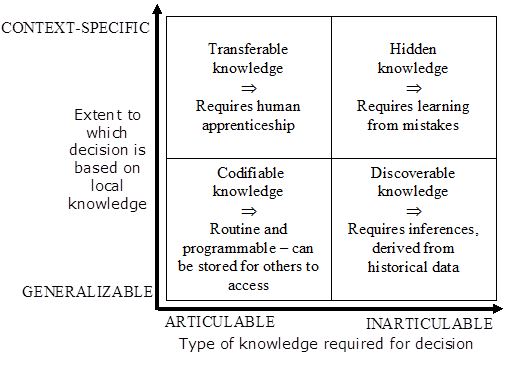
    In virtual organizations and distributed project groups, non-human objects increasingly mediate human relationships, as they displace humans as collaboration-partners in distributed knowledge networks. We may be able to identify forms of metaknowledge that work across domain boundaries by identifying mediating object roles – e.g. categorization schemes, instrumentation, databases, and routinized practices that embed frameworks for analysis or participation. My analysis has revealed different forms of group memory management in use, depending on the organizational scope of projects and the locus of control in the global network. Organizational knowledge – about how to work, how to frame organizational goals and outcomes, and how to organize work effectively – is mediated by technical objects, creating assemblages of social and technical systems of work, that guide the emergence of new business practices. The distributed scope of organizational locales creates four categories of knowledge that are acquired in different ways, summarized in Figure 1.

    2 x 2 matrix showing 4 forms of knowledge - these are described in the following text

    Figure 1. Forms of Knowledge (Gasson & Shelfer, 2006)

    Codifiable knowledge is the simplest to define, as this knowledge is routine and programmable. It equates to explicit knowledge, in that we know that we know it – and we can articulate what we know, so it can be stored for others to access and use. Typical examples are organization charts, or the rules, standards, and forms used in business processes.

    Transferable knowledge is articulable, but it is also situational – it is related to the context in which it is applied. For example, an IT systems developer might design software differently for a general-purpose website, whose users are relatively unknown, than for a small local application to be used by 4-5 people working together to perform specific business calculations as part of their shared work. The knowledge of when to apply different design techniques depends on the designers experience of working in various business environments and is generally acquired through some sort of apprenticeship process, where they learn from someone who has more experience of that environment.

    Discoverable knowledge is less straightforward. It combines tacit knowledge (Polanyi, 1961), which is process or skills based, with implicit knowledge that people fail to recollect consciously, or perceive explicitly (Schacter, 1991). As such knowledge is inarticulable, its possessors must recall it inferentially, by relating reported case studies to their own experience, or pattern recognition that can be related to data analysis findings. An effective way of surfacing such knowledge is to discuss historical data or case studies to explore what is known collectively about various situations. This is similar to the argumentation method proposed by Rittel (1972) in his discussion of “second generation design.”

    Hidden knowledge is the most difficult type to surface. It’s not the sort of knowledge that you are going to realize, unless you stop to reflect on what went wrong in your decision-making, or how an action was performed. For example, an IT Manager commented to me that the business process he had selected for a new initiative in organizational change was not as “stand-alone” as he had expected. He stopped to think, then commented that “in fact, I couldn’t have chosen a worse process to start with – it was related to every single business process we have.” Then he paused, and added, “but actually, you could say that about all of our business processes. It seems there is no such thing as a stand-alone process!” This category of knowledge is surfaced through breakdowns (Heidegger, 1962), where the “autopilot” of everyday action is disrupted by the realization that one’s usual recipe-for-success in such circumstances is not working. At that point, the tool or process we were about to use goes from being ready-to-hand, ready for automatic use, to being present-at-hand, needing reflection in order to work out how to use a tool, or how to behave in those circumstances (Winograd & Flores, 1986). During breakdowns, we need to stop and think, revising our mental model of how the world works to come up with a new way of behaving that is a better fit to the situation. Again, Rittel’s (1972) argumentation approach would be helpful here, as people pool and debate what they have learned from a failure, collectively.

    The ways in which we learn, then, are dictated by the scope of access that we have to our colleagues. The more distributed people are, the more that knowledge is mediated across formal technology channels, as distinct from being acquired through face-to-face conversations. This remoteness means that we are more reliant on formal knowledge, that is codifiable, or discoverable from formal sources of information. When people are co-located, they can spend time learning from what others do, or how a mistake or failure happened. They key take-away is that we need multiple ways of configuring and using technology platforms, for all types of knowledge to be supported. We cannot design one-size-fits-all information and communication technology systems.

    Selected Bibliography:

    Khazraee, E.K. & Gasson, S. (2015) ‘Epistemic Objects and Embeddedness: Knowledge Construction and Narratives in Research Networks of Practice’ The Information Society, 31(2), forthcoming, Jan. 2015.

    Gasson, S. (2015) “Knowledge Mediation and Boundary-Spanning In Global IS Change Projects.” Proceedings of Hawaii Intl. Conference on System Sciences (HICSS-48), Jan. 5-8, 2015. Knowledge Flows, Transfer, Sharing and Exchange minitrack, Knowledge Systems.

    Gasson, S. (2012) The Sociomateriality Of Boundary-Spanning Enterprise IS Design, in Joey, F. George (Eds.), Proceedings of the International Conference on Information Systems, ICIS 2012, Orlando, USA, December 16-19, 2012. Association for Information Systems 2012, ISBN 978-0-615-71843-9, http://aisel.aisnet.org/icis2012/proceedings/SocialImpacts/8/

    Gasson, S. (2011) ‘The Role of Negotiation Objects in Managing Meaning Across e-Collaboration Systems.’ OCIS Division, Academy of Management Annual Meeting, San Antonio, August 11-16, 2011.

    Gasson, S. and Elrod, E.M. (2006) Distributed Knowledge Coordination Across Virtual Organization Boundaries’, in Proceedings of ICIS ’06, Milwaukee, WI, paper KM-01. [Winner of ICIS Best paper in track award].

    Gasson, S. and Shelfer, K.M. (2006) ‘IT-Based Knowledge Management To Support Organizational Learning: Visa Application Screening At The INS’, Information, Technology & People, 20 (4), pp. 376-399. Winner of 2008 Emerald Literati outstanding paper award.

    DeLuca, D., Gasson, S., and Kock, N. (2006) ‘Adaptations That Virtual Teams Make So That Complex Tasks Can Be Performed Using Simple e-Collaboration Technologies’ International Journal of e-Collaboration, 2 (3), pp. 65-91

    References

    Heidegger, M. 1962. Being and Time. New York NY.: Harper & Row New York

    Polanyi, M. 1961. “Knowing and Being,” Mind (5:70), pp. 458-470.

    Rittel, H.W.J. 1972. “Second Generation Design Methods,” DMG Occasional Paper 1. Reprinted in N. Cross (Ed.) 1984. Developments in Design Methodology, J. Wiley & Sons, Chichester: 317-327.

    Schacter, D. L. (1992). Implicit knowledge: new perspectives on unconscious processes. Proceedings of the National Academy of Sciences, 89(23), 11113-11117.

    Winograd, T. and Flores, F. 1986. Understanding Computers and Cognition. Norwood New Jersey: Ablex Corporation.

  • Distributed Sensemaking

    Boundary-Spanning Design

    Distributed Sensemaking in Wicked Problems

    When collaborative innovation groups span knowledge domain boundaries, we have the additional complexity of distributed sensemaking. Boundary-spanning groups find it difficult to develop a common language for collaboration — often because they use similar terms to mean different things, or because they frame salient aspects of the problem-situation in different ways. We cannot, therefore, use the typical, goal-directed methods that we would use with a homogeneous design group (for example, IT professionals engaged in software design). We need methods that represent and permit reconciliation of the multiple frames of meaning encompassed by boundary-spanning collaborators.

    I have explored the processes underlying the co-design of business processes and information systems in boundary-spannning groups across multiple studies. We are faced with a wicked problem: one that can only be resolved through stakeholder argumentation, rather than analysis. Choices in the design of technology and the effects of alternative forms of technology on work are formed by definitions of organizational problems and, in turn, affect how organizational problems are defined. So design choices are emergent. Technology and process design, organizational innovation, problem-solving, and management decision-making are inextricably intertwined. The critical issue for organizational problem-solving and design groups is how we manage distributed sensemaking in collaborative knowledge processes. In groups with little shared experience or background – such as the typical enterprise systems design group, which is constituted of managers from different business groups and knowledge domains, understanding is stretched across group-members rather than shared between them. This concept is shown in Figure 1.

    Venn diagram, showing intersubjective frames,  intersections of understanding between 2 stakeholders, and distributed cognition as the union of all frames
    Figure 1. Venn Diagram Illustrating Different Categories of “Shared” Understanding

    Most collaboration methods, whether focused on enterprise systems design, business process redesign, cross-functional problem-solving, or IT support for business innovation, employ a decompositional approach, which fails dramatically because of distributed sensemaking. Group members cannot just share what they know about the problem, because each of them is sensitized by their background and experience to see a different problem (or at least, different aspects of the problem). Goals for change evolve, as stakeholders piece together what they collectively know about the problem-situation — a process akin to assembling a jigsaw-puzzle. (Productive) conflict and explicit boundary negotiation are avoided because group-members lack a common language for collaboration so misunderstandings are ascribed to political game-playing. We need design and problem-solving approaches that support the distributed knowledge processes underpinning creativity and innovation — approaches that recognize and embrace problem emergence, boundary-negotiation, and the development of shared understanding.

    Selected Papers:

    Gasson, S. (2013) Framing Wicked Problems In Enterprise-System Design Groups, Ch. 4 in Boundary-Spanning in Organizations: Network, Influence, and Conflict, Janice Langan-Fox and Cary L. Cooper (Eds.), Routledge, Taylor and Francis, New York.

    Gasson, S. (2006) ‘A Genealogical Study of Boundary-Spanning IS Design ’, European Journal of Information Systems, Special issue on Action in Language, Organizations and Information Systems. 15 (1), pp. 1-16.

    DeLuca, D., Gasson, S., and Kock, N. (2006) ‘Adaptations That Virtual Teams Make So That Complex Tasks Can Be Performed Using Simple e-Collaboration Technologies‘, International J. of e-Collaboration, 2 (3), pp. 65-91.

    Gasson, S. (2005) ‘The Dynamics Of Sensemaking, Knowledge and Expertise in Collaborative, Boundary-Spanning Design‘, Journal of Computer-Mediated Communication (JCMC), 10 (4). http://jcmc.indiana.edu/vol10/issue4/gasson.html

    Gasson, S. (1998) ‘Framing Design: A Social Process View of Information System Development‘, in Proceedings of ICIS ’98, Helsinki, Finland, December 1998, pp. 224-236.

  • Improvising Design for Wicked Problems

    Improvising Design for Wicked Problems

    IT-related change in complex business organizations involves the co-design of business (work-activity) systems and systems of IT. These designs emerge, as we learn about the situation as we deal with wicked problems.

    Wicked problems are the type of interrelated, subjective problems that we encounter in organizational change. We can never resolve (or even agree) such complex problems in one go – each stakeholder has a different perspective on what the problems are. As Rittel & Webber (1973) observed, there is no single problem definition – and no stopping point by which to judge if you are finished.

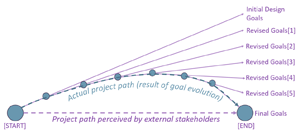
    Goal-based design is a myth. Instead, we face emergent design, comprising cycles of inquiry, systemic analysis, organizational & IT change, and evaluation. The best we can do is to agree a scope for action, analyze the problems within that scope and take action, then evaluate whether we made the situation better or worse. Design is emergent because we constantly need to change our scope and goals, depending on that evaluation – and on changes to organizational goals in response to a changing business environment.

    IT and change management fail when they are managed as if each project is self-contained. Instead, we need to manage these processes as a single cycle in an ongoing process of managing organizational fit with an evolving business environment.

    Emergent Design

    Parabolic trajectory followed by the design process as goals emerge over time

    Explore the co-design of business and IT systems, why wicked problems require improvisational design, and appreciate the history of IS design.

    Systemic Analysis

    Interconnectedness of elements from systems thinking perspective

    Understand what systemic analysis involves and why you need to use it!
    Then explore Soft Systems Analysis, a method for defining change to business processes and IT in tandem

    Human-Centered Collaboration

    Two stick men communicating with metal cans and string

    Appreciate the difference between user-centered and human-centered design, how to design knowledge systems, and how to understand requirements for boundary-spanning systems .

    References

    Rittel, H.W.J., and Webber, M.M. “Dilemmas in a General Theory of Planning,” Policy Sciences (4:155-169) 1973.